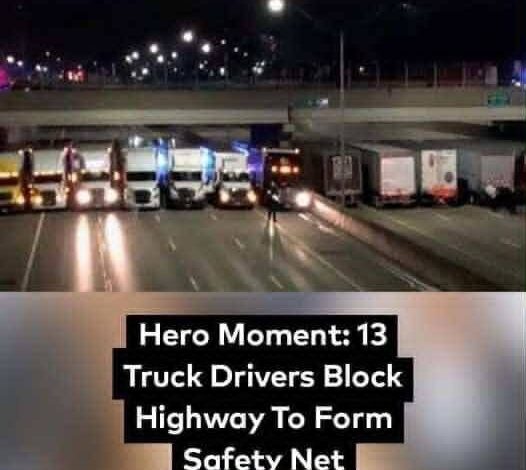
Traffic on Interstate 696 in Huntington Woods, Michigan, came to a sudden and complete standstill on what should have been an ordinary day. Drivers slowed, then stopped entirely, staring ahead in confusion. Thirteen massive trailer trucks sat motionless beneath a bridge, perfectly aligned, blocking every lane. There were no flashing accident signs, no visible wreckage, no overturned vehicles. Just trucks. Waiting. Silent.
At first, frustration spread through the line of cars. People checked their watches, tapped steering wheels, sent messages explaining they would be late. Some assumed there had been a serious crash ahead. Others guessed road construction or a police operation. Minutes turned into longer stretches of waiting, and curiosity replaced impatience. Something about the stillness felt deliberate.
Earlier that day, Michigan State Trooper Michael Shaw received an emergency call. A man was standing on the bridge above I-696, distraught and threatening to jump. The situation was critical. Any sudden movement, loud noise, or misstep could turn the moment irreversible. Shaw knew the standard crisis response was already underway—negotiators, emergency services, mental health professionals—but he also knew something else: even with the best efforts, outcomes are never guaranteed.
Standing beneath that bridge, Shaw made a split-second decision that would later be described as both simple and brilliant.
If the man jumped, there needed to be something beneath him that could save his life.
Shaw immediately contacted another traffic officer and asked for help redirecting vehicles. Then he reached out to nearby truck drivers traveling the highway. His request was unusual, urgent, and required trust. He asked if they would be willing to park their trucks directly under the bridge and remain there for as long as necessary.
There was no obligation. No official order. Just a call for help.
One by one, the drivers agreed.
Thirteen truckers maneuvered their massive vehicles into position beneath the bridge, carefully aligning them to cover as much ground as possible. Together, the trailers formed a wide, solid barrier—an improvised safety net of steel and rubber. If the man jumped, the trucks would prevent him from hitting the pavement below, greatly reducing the risk of fatal injury.
Once the trucks were in place, traffic on the highway was completely halted. Drivers stuck in their cars had no idea yet that they were participating in a life-saving effort simply by waiting.
Above them, the situation unfolded slowly and painfully. The man on the bridge was deep in crisis, overwhelmed by whatever weight had brought him there. Negotiators spoke with him for hours, carefully choosing words, listening more than talking, offering presence instead of pressure. Time stretched. Four long hours passed.
Below, the truck drivers stayed exactly where they were.
They didn’t complain. They didn’t leave. They didn’t ask how long it would take. Engines idled. Some drivers stepped out briefly, checking their rigs, then climbed back in. Others sat quietly in their cabs, watching the bridge, understanding fully why they were there. Their schedules were blown apart. Deliveries delayed. Pay potentially affected. None of it mattered.
What mattered was that someone’s life hung in the balance.
Eventually, the moment everyone hoped for arrived. The man stepped away from the edge. He was taken safely off the bridge and immediately connected with psychological and medical support. No jump. No tragedy. No sirens echoing the aftermath of loss.
Only then were the trucks guided out of formation, traffic slowly released, and drivers allowed to continue on their way.
As the highway reopened, word began to spread. Drivers rolled past the bridge with a new awareness, some wiping their eyes, others sitting in stunned silence. The inconvenience they had endured suddenly felt insignificant. What they had been part of—knowingly or not—was something far bigger than a traffic delay.
The truck drivers who helped never asked for recognition. Many didn’t even know the full outcome when they finally pulled away. They simply responded when asked, using the tools they had—their vehicles, their time, their willingness—to protect a stranger they would never meet.
Trooper Michael Shaw later explained that the idea came from thinking ahead, not assuming the worst, but preparing for it. He didn’t want to rely on hope alone. He wanted a backup plan that could save a life if words failed.
And the truckers made that plan possible.
Stories like this cut through the noise of daily headlines. They remind us that compassion doesn’t always arrive loudly or dramatically. Sometimes it shows up in the form of people doing their jobs, choosing patience over profit, and understanding that human life outweighs schedules, deadlines, and inconvenience.
Empathy can feel rare in a world that moves fast and argues loudly. But on that stretch of Michigan highway, empathy took physical shape—thirteen trucks, lined up with purpose, waiting as long as it took.
The man on the bridge received the help he needed. The drivers eventually reached their destinations. Traffic resumed. Life moved forward.
But for everyone who learned what really happened that day, the image remains powerful: strangers cooperating without hesitation, guided by the simple belief that if you can help someone survive their darkest moment, you do it.
No questions. No conditions. Just action.
And sometimes, that’s enough to make all the waiting worth it.