Part 1
The first week in a new house is supposed to feel like a reset button. Fresh paint, unfamiliar creaks, and that faint hope that whatever followed you from the last place won’t find the new address.
Mine didn’t even make it to day eight.
It was late afternoon in Beaverton, the kind of Oregon gray that turns every window into a dim mirror. I stood in my workshop behind the garage, hands greasy from a stubborn hinge, and listened to the soft rain tick against the roof like impatient fingers. The workshop smelled like cedar and machine oil, the only scents that still made sense to me since Patricia died. Three years, and I still caught myself doing small repairs as if she might step out back, wrinkle her nose, and say, “Vincent Carter, you’re going to get that on your good shirt.”
I didn’t have good shirts anymore. I had shirts that fit, shirts that didn’t, and a jacket I kept wearing because it still held her perfume in the stitching if I pressed the collar to my face.
The phone buzzed in my pocket. Unknown number.
In a small town, you answer unknown numbers. It’s the plumber, the pharmacy, the kid at the hardware store who can’t find your order, or a neighbor who lost a dog.
I wiped my hands on my jeans and picked up.
“Mr. Carter?” The voice was tight, breathy, like he’d been running.
“Yes.” I steadied my tone out of habit. Forty years of engineering taught me that panic doesn’t fix anything. It only makes the next decision sloppy.
“This is Warren Phillips. I’m… I’m the previous owner of your house.”
I glanced toward the back door, toward the stretch of lawn that was still half boxes and half good intentions. I’d met Warren only twice: once at closing, once when he brought over a small bag of screws he’d “forgotten in the kitchen junk drawer.” He was seventy-two, retired postal worker, a man with the careful politeness of someone who spent his life in line with other people’s mail.
“Warren.” I tried to sound friendly, casual. “Everything okay?”
“No. And I need you to listen to me.” The words came out fast, sharp. “I made a mistake. The living room camera. I didn’t turn it off.”
My stomach gave a slow, uneasy roll.
When I bought the house, the previous security system was still mounted near the ceiling corners: small, unobtrusive cameras Warren had installed after a string of porch thefts hit the neighborhood. He offered to leave them for me. I agreed, mostly because I was too tired to fight about anything. Too tired to argue about a house, too tired to admit that what I was really buying was a place where the memories of my old home couldn’t ambush me in every hallway.
We’d discussed transferring the system. He said it was simple.
Apparently, it wasn’t.
“You… still have access?” I asked.
“I shouldn’t. I didn’t mean to. I forgot to disconnect the cloud account from my tablet.” He swallowed audibly. “I wasn’t spying. I swear to God, I wasn’t. It popped up while I was trying to fix the settings. And I saw something.”
A cold thread tightened across my ribs.
“What did you see?” I asked.
Silence, then a shaky inhale.
“It’s about your sister-in-law,” Warren said.
My hand tightened around the phone.
Olivia Morrison. Patricia’s younger sister. She wasn’t blood, but she’d been in my life for twenty-seven years, long enough to stop thinking of her as “in-law” and start thinking of her as family in the truest sense: the people who know where the good plates are kept and feel entitled to rearrange your pantry.
After Patricia’s funeral, Olivia had been the one to show up unasked with casseroles and coffee and a too-bright smile that kept my daughterless house from collapsing into total silence. She brought her little girl, Emma—five now, all freckles and endless questions. Emma had sat on my porch swing one spring day and announced, with the absolute certainty of childhood, “Grandpa Vin, when I grow up I’m going to build a house with a slide in it.”
I wasn’t her grandpa, not technically. But she called me that anyway, and I let her, because some titles are earned in the space between loss and survival.
So when Warren said Olivia’s name like it was a warning label, my first instinct was to reject it. To push back, to demand he take it back.
“You’re sure?” I heard myself say, as if certainty could make the next sentence less lethal.
“I’m sure enough that I called you.” His voice dropped to a whisper. “And I can’t tell you over the phone. I need you to come here. Alone.”
My heart began to beat in a new rhythm, one I hadn’t heard since Patricia’s diagnosis. Fast, wrong, like something inside me had realized before my mind did that the ground was shifting.
“Warren,” I said, “if this is—”
“It’s real.” He cut me off, and there was something in his tone that didn’t belong to gossip or nosiness. It belonged to fear. “You need to see it with your own eyes. Don’t tell anyone. Don’t call her. Don’t even text. Come alone. Now.”
I looked down at the hinge in my hand, the screw half-set, the door still crooked. The workshop was warm, familiar, controllable. My world, for the last three years, had been built out of small, solvable problems.
This didn’t sound solvable.
“What did she do?” I asked anyway, because the question climbed up my throat like bile.
Warren’s breath stuttered. “It’s not just her. It’s her husband too. Trevor. And… and there are papers.”
Papers.
My mind flipped through images: the stack of closing documents still on my kitchen counter, the file folder marked “Estate Planning” that I hadn’t had the courage to open since Patricia’s death, the health directive I’d signed last month after a scare with my blood pressure. Simple precaution. Responsible adult stuff.
Papers.
My workshop suddenly felt smaller, as if the walls had leaned in to listen.
“Where are you?” I asked.
“My house. Three doors down from yours, the one with the blue siding. You know it.”
“I know it.”
“Please,” he said, and the word held a weight that made my throat tighten. “Please don’t bring anyone.”
The call ended. Not with a goodbye. Just the empty click of a man who’d dropped a match and was watching the fire spread.
I stood there for a full ten seconds with the phone pressed to my ear, listening to nothing.
Then I moved.
I didn’t clean up. I didn’t lock the workshop. I didn’t do any of the small rituals I’d built into my routine to make life feel stable. I walked fast to my truck, rain dampening my hair, the cold seeping into my bones.
As I backed out of the driveway, I saw the house through my rearview mirror. New curtains in the windows. A welcome mat Patricia would have hated because it was too cheerful. A stack of moving boxes still visible through the front glass.
My new start.
And somewhere inside that living room, a camera I hadn’t asked for was apparently watching my life like it was a show.
The drive to Warren’s house took less than two minutes. It felt like an hour.
When I pulled into his gravel driveway, Warren was already at the door, pale and rigid, as if he’d been holding his breath since the moment he dialed my number.
He didn’t greet me. He didn’t offer coffee. He just stepped aside and motioned me in.
His den smelled like old paper and faint tobacco. A single lamp cast a weak pool of yellow light over a cluttered desk. On it sat a laptop, open, the screen glowing.
Warren shut the door behind me with a careful, deliberate click.
“Before you see it,” he said, voice hoarse, “I need you to understand something. I didn’t go looking. I swear I didn’t.”
I nodded, but I didn’t trust my voice.
He gestured toward the chair. I didn’t sit.
Warren’s hand hovered over the mouse. It shook so badly I could see it from across the room.
“I know what it feels like,” he said quietly. “To think you know someone. To bet your whole life on them. And then to find out they were counting the minutes until you looked away.”
He clicked.
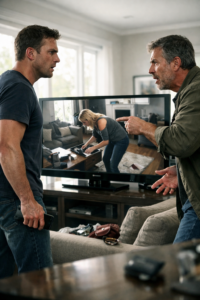
The screen flickered. Then the feed sharpened, and my living room appeared in grainy, unforgiving clarity.
My sofa. My lamp. My coffee table.
And Olivia Morrison, sitting at the edge of the cushion like she didn’t belong there.
Trevor beside her, relaxed, smiling.
A blue folder open on my table.
My blue folder.
The kind I kept in my desk drawer because Patricia always said, “Important papers don’t go where people can see them.”
My breath stopped.
Warren’s voice was a thin thread behind me. “I’m sorry, Vincent.”
On the screen, Trevor reached into the folder and pulled out a document.
And he laughed—soft, confident, like this was all just a game.
Then he lifted a pen.
And I watched him sign my name.
My mind flipped through images: the stack of closing documents still on my kitchen counter, the file folder marked “Estate Planning” that I hadn’t had the courage to open since Patricia’s death, the health directive I’d signed last month after a scare with my blood pressure. Simple precaution. Responsible adult stuff.
Papers.
My workshop suddenly felt smaller, as if the walls had leaned in to listen.
“Where are you?” I asked.
“My house. Three doors down from yours, the one with the blue siding. You know it.”
“I know it.”
“Please,” he said, and the word held a weight that made my throat tighten. “Please don’t bring anyone.”
The call ended. Not with a goodbye. Just the empty click of a man who’d dropped a match and was watching the fire spread.
I stood there for a full ten seconds with the phone pressed to my ear, listening to nothing.
Then I moved.
I didn’t clean up. I didn’t lock the workshop. I didn’t do any of the small rituals I’d built into my routine to make life feel stable. I walked fast to my truck, rain dampening my hair, the cold seeping into my bones.
As I backed out of the driveway, I saw the house through my rearview mirror. New curtains in the windows. A welcome mat Patricia would have hated because it was too cheerful. A stack of moving boxes still visible through the front glass.
My new start.
And somewhere inside that living room, a camera I hadn’t asked for was apparently watching my life like it was a show.
The drive to Warren’s house took less than two minutes. It felt like an hour.
When I pulled into his gravel driveway, Warren was already at the door, pale and rigid, as if he’d been holding his breath since the moment he dialed my number.
He didn’t greet me. He didn’t offer coffee. He just stepped aside and motioned me in.
His den smelled like old paper and faint tobacco. A single lamp cast a weak pool of yellow light over a cluttered desk. On it sat a laptop, open, the screen glowing.
Warren shut the door behind me with a careful, deliberate click.
“Before you see it,” he said, voice hoarse, “I need you to understand something. I didn’t go looking. I swear I didn’t.”
I nodded, but I didn’t trust my voice.
He gestured toward the chair. I didn’t sit.
Warren’s hand hovered over the mouse. It shook so badly I could see it from across the room.
“I know what it feels like,” he said quietly. “To think you know someone. To bet your whole life on them. And then to find out they were counting the minutes until you looked away.”
He clicked.
The screen flickered. Then the feed sharpened, and my living room appeared in grainy, unforgiving clarity.
My sofa. My lamp. My coffee table.
And Olivia Morrison, sitting at the edge of the cushion like she didn’t belong there.
Trevor beside her, relaxed, smiling.
A blue folder open on my table.
My blue folder.
The kind I kept in my desk drawer because Patricia always said, “Important papers don’t go where people can see them.”
My breath stopped.
Warren’s voice was a thin thread behind me. “I’m sorry, Vincent.”
On the screen, Trevor reached into the folder and pulled out a document.
And he laughed—soft, confident, like this was all just a game.
Then he lifted a pen.
And I watched him sign my name.
Part 2
The strangest part of watching someone forge your signature is how ordinary it looks.
A pen scratches across paper. A wrist moves. A line curves where it should curve. A dot lands where it should land. There’s no dramatic music, no thunderclap, no cinematic cue that tells you this is the moment your life splits into before and after.
On Warren’s laptop, my living room sat still and familiar, like it had no idea it was being turned into a crime scene.
Olivia’s hands were knotted in her lap. She kept twisting a blue cardigan—one I recognized instantly because I’d given it to her last Christmas. It felt like watching someone wrap themselves in your kindness while they sharpened a knife.
Trevor leaned back, all confidence. The man had always looked harmless in daylight: clean hair, polite grin, the type who offered to carry groceries and talked about “family values.” He worked in logistics and liked to brag about his “head for numbers,” which, in hindsight, should’ve been my first clue that he saw the world as columns of gain and loss.
On the screen, he tapped the page with his pen.
“See?” Trevor said, his voice thin through laptop speakers. “This is the part he never reads. Old guys don’t read. They just trust the person holding the paper.”
Olivia glanced toward the hallway, as if she expected me to appear in the doorway. I felt a sick instinct to step into my own living room, to interrupt the footage like a man could break into the past and stop the damage mid-swing.
But I was standing in Warren’s den, staring at pixels.
“Trevor,” Olivia whispered. “What if he checks?”
Trevor’s smile widened. “Vincent Carter doesn’t check anything. He builds birdhouses and drinks black coffee and thinks people mean what they say.” He signed again, slower this time, savoring it. “Besides, even if he did notice, it’ll be too late.”
Olivia swallowed. “I just… I don’t want him hurt.”
Trevor snorted, like the idea was adorable. “He’s not getting hurt. He’s getting… reorganized. It’s not stealing if it was always going to stay in the family.”
My stomach clenched so hard I thought I might fold in half.
Warren shifted behind me. I could feel him watching my shoulders, like he expected me to swing around and punch the screen. Maybe he would’ve understood if I had. He’d said on the phone he’d been robbed by his own son years ago. Men like that recognize the moment another man’s trust dies.
On the laptop, Trevor slid another paper forward.
“This one’s the key,” he said. “The health directive. That’s what he thinks he signed.”
Olivia frowned. “He did sign a health directive.”
“He signed what I gave him,” Trevor corrected. “And what I gave him had two extra pages in the middle. Look.” He flipped the packet open, showing her the fine print. “Authority. Accounts. Property. It’s clean. Once it’s filed, we can move everything without him ever lifting a finger.”
Olivia’s face went gray, like she’d swallowed cold ash.
“You said this was just for the house,” she murmured.
“It is for the house,” Trevor said, impatient. “And the 401k. And his savings. Everything. We need liquidity.” He leaned forward, voice dropping. “You know what happens if we don’t.”
Olivia’s eyes flicked down. “Emma.”
Hearing my niece’s name—my bright little Emma—felt like someone drove a nail through my chest.
Trevor’s tone softened into something predatory. “Exactly. So you help me. Because you’re her mother. And because you love her.” He reached out, tapped Olivia’s knee like he was consoling her. “And because your brother-in-law trusts you, Liv. That’s his weakness.”
Olivia’s mouth opened like she wanted to argue. Like she wanted to say, This is wrong. This is disgusting. This is not who I am.
But then she nodded. Once.
A single motion that shattered something in me so quietly I almost didn’t register it until it was gone.
Warren paused the video.
The screen froze on Olivia’s face, half-lit by my living room lamp, eyes wet, lips pressed together. A woman caught between guilt and greed, between fear and loyalty, choosing the wrong side because it was easier than being brave.
Warren’s voice trembled. “There are more.”
“How many?” I asked.
He glanced at the folder on his desktop. “Five total. Different days. Different conversations.”
My phone buzzed in my pocket. A file transfer notification. Then another. Then another. Each vibration felt like a hammer striking a beam that was already cracked.
Warren swallowed hard. “I sent them to you. You should have them all.”
I stared at the frozen image.
In my mind, I saw Olivia at fourteen, crying on my porch because her father had left again. Patricia and I had let her stay for weeks that summer. I remembered her sleeping on our couch with a blanket pulled up to her chin, safe. I remembered promising Patricia we’d always look out for her sister.
Patricia’s voice echoed in my head: Family is who you protect.
The frozen screen looked like a violation of that promise.
I forced my eyes away, because if I kept staring, I might break in a way I couldn’t put back together.
“Thank you,” I said, and my voice sounded like it belonged to someone else. A calmer man. A man with no blood in his veins.
Warren flinched. “Vincent—”
“I said thank you.” I swallowed. “You didn’t have to call.”
“Yes, I did,” he said quietly. “Because I know what it feels like to lose your life to people who smile at your table.”
I stood there for another moment, then turned toward the door. My legs moved like they were made of wood.
Outside, the rain had thickened. The porch light cast a pale circle on the wet boards. I breathed in the cold, letting it stab the inside of my lungs, because pain was something I understood.
The drive home should’ve been short, but I didn’t go home.
I couldn’t.
I pulled into a twenty-four-hour diner on Canyon Road, parked under a buzzing neon sign, and sat in a corner booth with a cup of black coffee I didn’t touch. The smell of grease and disinfectant filled the air, and it was strangely comforting because it didn’t belong to my life.
I opened my phone. The files Warren sent were labeled with dates and times.
I tapped the second one.
My living room appeared again.
This time, Trevor had a legal pad out. He was explaining steps like he was building a shelf. Precise. Methodical.
“The alerts go to the new email,” he said. “Not his. Ours. He’ll never see the county clerk notification.”
Olivia’s voice was brittle. “Is that legal?”
Trevor laughed. “Legal is whatever you can prove. And you can’t prove anything if you don’t know it happened.”
I stared at the screen until the edges blurred.
This wasn’t an impulsive theft. This wasn’t desperation in a single bad moment.
This was a plan.
A timeline.
A deadline.
Trevor circled a date on the calendar. September 30.
My thumb hovered over the pause button, but I didn’t press it. I didn’t look away, because I knew the moment I stopped watching would be the moment I let denial crawl back in.
Then the third file opened.
Trevor was pacing my living room, phone pressed to his ear. His voice was a low, jagged whisper.
“One-eighty,” he hissed. “You’ll have it. By the thirtieth.”
A different voice crackled back, distorted, impatient. I couldn’t make out the words, but I heard the threat in the cadence.
Trevor’s shoulders tightened. “Don’t talk about the kid. I said you’ll have it.”
I froze.
The kid.
Emma.
My hands began to shake so hard the phone nearly slipped from my grip.
On the screen, Olivia stumbled into frame, cheeks wet, face swollen from crying.
Trevor turned on her like a switch flipped.
“If this doesn’t clear,” he said, voice sharp, “they’ll go to the school.”
Olivia made a sound I’ll never forget. Not a sob. Not a scream. Something quieter. The sound of a person’s soul trying to crawl out of their body to escape what they’d helped create.
I pressed my palm to the table, steadying myself.
In my head, I saw Emma’s small sneakers on my porch, her laugh in my garden, her hands digging in soil to plant Patricia’s roses.
A deadline on a calendar didn’t scare me. I’d lived my whole career by deadlines.
A threat to a child did.
I watched the fourth file.
Trevor in my kitchen at midnight, talking to a woman in a voice he never used around Olivia. Soft. Intimate. Excited.
“Costa Rica,” he murmured. “We’re almost there.”
The woman giggled, bright and careless.
Trevor chuckled. “Olivia’s useful. That’s all.”
Useful.
I swallowed bile.
Then the fifth file loaded.
Olivia and Trevor again, but this time she looked like she’d been hollowed out. She tried to back out, voice shaking.
Trevor grabbed her arm. Hard enough to leave marks.
And then he recited, like he was reading a grocery list, Emma’s recess schedule at Hawthorne Elementary.
“Ten fifteen,” Trevor said. “You want them waiting by the fence at ten fifteen?”
I stopped breathing.
The diner around me kept moving. A waitress refilled someone’s coffee. A trucker laughed at a joke. Plates clinked.
My world narrowed down to the tiny speaker on my phone and the voice of a man using my niece’s life as collateral.
I set the phone down, hands flat on the table, and stared at the chipped edge of the booth like it held the answer.
I’d spent my life designing structures to survive stress. Wind, weight, time.
Now my family’s structure had failed, and I could see exactly where the load-bearing points had snapped.
I pulled out a yellow legal pad. The waitress asked if I wanted a refill. I didn’t look up; I just nodded.
I drew a line down the middle of the page and wrote two words at the top.
Protect.
Punish.
Then I looked at the date on my phone.
September 20.
Ten days until September 30.
Ten days until Trevor tried to steal my home.
Ten days until he delivered my niece to whatever monsters he owed.
I picked up my pen.
Within the next seventy-two hours, I would build a trap so tight a man like Trevor Morrison would walk into it smiling.
And then the door would lock behind him.
Part 3
By the time I left the diner, the rain had stopped, but the air still tasted like wet asphalt and old secrets. Beaverton was quiet in that late-night way that makes you feel like every house on every street is holding its breath.
Mine included.
I sat in my truck in the driveway, engine off, staring at my front window. The living room lamp was still on. I’d left it earlier in a rush, and now the warm rectangle of light looked like an invitation. Or a target.
I thought about the camera in the corner of that room, the one Warren had “forgotten” to disconnect. I wondered how many small mistakes had stacked up to create this moment. How many times I’d trusted the wrong person because I wanted my world to stay simple.
I didn’t go inside right away. I opened my phone again and replayed Trevor’s voice saying ten fifteen.
I forced myself to listen until the words lost their shock and became data. I’d always handled fear by turning it into information. Engineers don’t defeat storms by praying the wind will change. We calculate load. We reinforce joints. We design redundancies.
So I did what I always did when something threatened the integrity of what I loved.
I made a plan.
First: protect the innocent.
Emma.
Second: stop the theft.
Third: make sure Trevor couldn’t hurt anyone ever again.
Olivia wasn’t first on the list. That realization felt ugly, but it was true. Olivia was an adult who’d made choices. Emma was a child trapped in those choices.
I finally went inside, locking the door behind me with a click that sounded too small for how much it meant. I walked through the house without turning on more lights, moving in a dim tunnel of shadows. In the kitchen, I poured water I didn’t drink. In the hallway, I paused by a framed photo of Patricia, her smile caught in a summer moment that felt like a different lifetime.
I whispered, “I’m sorry,” to the empty air.
Then I went to my desk.
The blue folder Trevor had handled on the video wasn’t there anymore. I’d put it in a drawer the day I moved in, out of habit. But I checked anyway. The drawer slid open smoothly. Nothing looked disturbed. Nothing looked wrong.
And that’s how betrayal works. It’s never loud. It’s never obvious until the damage is done.
I sat down and opened my laptop.
I didn’t use my own browser. I didn’t use my own email. I grabbed the cheap tablet I kept for crossword puzzles and went into incognito mode like I was a teenager sneaking around my parents’ rules.
I searched for elder law attorneys.
Power of attorney fraud.
Identity theft.
Emergency custody Oregon.
The screen filled with names and ads and promises. Most of them looked like billboards in legal form: bright smiles, empty slogans.
Then I found Evelyn Chambers.
Her website didn’t have a smiling headshot. It had a simple statement: Protecting seniors from exploitation and abuse.
Her reviews weren’t gushy. They were grateful. Words like relentless and sharp and doesn’t miss a detail.
I wrote her number on my legal pad.
Then I sat there, staring at the digits, realizing that making the call meant accepting something final: I couldn’t fix this inside the family. I couldn’t solve it with a talk at the dinner table. This had moved beyond hurt feelings and misunderstandings.
This was a crime.
I dialed.
A receptionist answered, crisp and efficient. I told her my name, and I chose my words carefully. I didn’t say my sister-in-law tried to steal from me. That sounded like messy family drama.
I said, “I believe my power of attorney documents have been manipulated.”
There was a pause.
Then the receptionist’s tone changed, a degree colder, a degree more serious.
“Can you come in Friday at nine-thirty?”
“Yes,” I said. “I’ll be there.”
When I hung up, I felt the first small shift in momentum. Like a beam that had begun to crack was finally being braced.
But momentum doesn’t erase grief.
I stared at my phone. Olivia’s name sat in my contacts, innocent as ever, a simple line of text that represented decades of family dinners and birthdays and long talks on Patricia’s porch.
I didn’t call her.
Not yet.
Instead, I walked through the house the way a man walks through a building he suspects is structurally compromised. I looked for signs. Something out of place. Something that didn’t belong.
In the dining room, nothing.
In the living room, nothing.
Then, as I moved to the hallway, my foot brushed something under the edge of the rug near my chair. A slight bump. A hard shape.
My skin prickled.
I knelt down and lifted the rug.
A tiny black device, taped to the underside of the chair with cheap adhesive.
A microphone.
For a moment, I couldn’t move. I couldn’t breathe. I stared at it like it was a venomous insect.
Trevor wasn’t just stealing papers. He was listening.
I sat back on my heels, the floor cold under my knees, and tried to control my breathing. My hands shook, but I forced them steady as I peeled the tape loose.
The microphone was light. Cheap. The kind you could buy online for the price of a nice dinner. It sat in my palm like a physical insult.
I thought about Trevor and Olivia in my living room, planning. I thought about Trevor’s calm voice, the way he’d spoken like he owned my home already.
I could smash the microphone. Tear it apart. Throw it in the trash.
But then Trevor would know something changed.
And a trap doesn’t work if the animal sees the wire.
So I did something that made my stomach twist.
I taped it back.
I put the rug down carefully, smoothing the edge like nothing had happened.
If Trevor wanted to listen, he could listen to whatever story I chose to tell.
I went to bed at ten, exactly as I usually did. I brushed my teeth. I turned off lights. I moved through the motions like a man performing normal.
But my mind didn’t sleep.
I lay in the dark and thought about September 30 circled in red ink.
I thought about Emma’s recess schedule.
I thought about how easily a man like Trevor could convince Olivia that there was no other way. How fear can turn decent people into accomplices.
And I thought about something else: when I bought this house, I’d assumed the cameras were for safety. Porch thieves. Neighborhood nonsense.
But the most dangerous thieves were already inside.
Thursday morning, Olivia called at exactly ten.
I watched the phone ring twice before I answered. Not because I wanted to, but because I needed to keep the performance believable.
“Hi, Vin,” she said, voice bright with practiced concern. “Just checking in. How are you doing in the new place?”
I stared at the kitchen wall as if it might help me see through her tone.
“I’m fine,” I said gently. “Unpacking. Fixing little things.”
“That sounds like you.” She laughed softly. “Emma misses you. She keeps asking when she can come over and see the garden.”
My throat tightened. Emma was always the cleanest part of Olivia’s voice. The place where real affection still lived.
“Tell her she can come anytime,” I said.
Olivia hesitated, just a beat too long. Then: “Trevor and I were thinking of stopping by tomorrow afternoon. He wants to help you with the fence.”
The fence.
I heard the line from the video in my head: He’ll never see it coming.
“Sure,” I said. “I’ll make tea.”
“Great,” she said, relief spilling into her voice like she’d won something. “See you tomorrow.”
When the call ended, I stood in my quiet kitchen and felt my face go cold.
Tomorrow afternoon was too soon. Friday morning was my meeting with Evelyn Chambers. I needed time. I needed the legal bracing in place before the predators made their final move.
I checked the doors. I checked the windows. I checked the workshop.
The workshop door was slightly ajar.
My heart dropped.
I stepped inside, breathing in the familiar cedar scent, and scanned the space. Tools hung in neat rows. Wood scraps sat in bins. Everything looked the same.
But then I noticed the laptop on my workbench. The lid was closed, but the angle was wrong. Slightly shifted, like someone had touched it.
Trevor had been here.
I opened the laptop. The login screen blinked back at me.
No obvious sign of access. No files open.
But I knew. The way you know when a screw has been tightened by someone else. The way you know when a structure has been tampered with even if the surface looks clean.
I shut the lid slowly.
So that was the play: distract me with tea, wander the workshop, find account numbers, locate the original deed.
They wanted the paper that made the theft irreversible.
And they were getting impatient.
Friday morning couldn’t come fast enough.
I set my alarm for five-thirty.
Then I sat at my desk and wrote a new line under Protect.
Secure assets.
Under Punish, I wrote:
Let him confess.
Because that was the thing about predators like Trevor Morrison. They believed their own cleverness made them untouchable.
If I built the trap correctly, he wouldn’t just get caught.
He’d walk in bragging.
Part 4
Friday came with a sky the color of cold steel. I dressed the way I used to for meetings at the firm: clean shirt, plain jacket, nothing that drew attention. I looked in the mirror and saw an older man with tired eyes and a jaw set hard enough to crack stone.
Patricia would’ve touched my cheek and told me to soften. She hated when I looked like I was heading into a fight.
I was.
Evelyn Chambers’s office sat in a quiet building with dark windows and a lobby that smelled like polished wood and expensive coffee. Her receptionist led me down a hallway and into a room where the air felt still and sharp, like the inside of a safe.
Evelyn was fifty-six, hair pulled back, eyes steady and unsentimental. She didn’t offer me comfort. She offered me competence.
I placed my folder—screenshots, timestamps, copies of the documents I’d signed—on her desk.
“I need you to build me a wall,” I said.
Evelyn flipped through the evidence without a flicker of surprise. Her finger paused on a clause in the “health directive” that granted broad financial authority.
“You didn’t intend this,” she said.
“No,” I said. “I intended to make sure no one pulled the plug if I had a stroke.”
Evelyn nodded once, like she’d heard the same story too many times. “We revoke it today. Immediately. We notify the county recorder and your bank. We put a fraud alert on your identity. And we document everything.”
A week ago, I would’ve flinched at the word fraud alert. It would’ve felt dramatic. Now it felt like calling the fire department when smoke fills the hallway.
Evelyn slid papers toward me. Revocation documents. Emergency declarations. Notices that would turn Trevor’s confidence into useless noise.
I signed with a steady hand.
Evelyn watched me, then said quietly, “This will burn bridges.”
“They already burned,” I replied.
After the notary stamp hit the page with a hard metallic click, Evelyn leaned back. “Now tell me about the child.”
I told her about Emma. About ten fifteen. About the fence line. About the way Trevor spoke like he’d priced her life.
Evelyn’s eyes narrowed. “That changes the posture,” she said. “That’s not just civil. That’s safety. That’s criminal.”
By noon, I was at my bank, meeting with a personal banker who’d known Patricia by name. We moved funds, locked accounts, changed recovery emails, set transaction limits that required my physical presence for anything over five thousand.
The money was a number on a screen, but it represented forty years of work. Bridges designed. Contracts earned. Late nights. The kind of labor you don’t get back if someone steals it with a pen.
When the final confirmation came through, I felt something loosen in my chest.
One pillar reinforced.
But pillars aren’t enough if the roof is already on fire.
That afternoon, Olivia and Trevor arrived early.
I saw their car through the window and felt my muscles go rigid. Emma hopped out first, waving her coloring book like a flag. Her smile cut straight through my anger, and for a moment, I remembered what it felt like to love without calculation.
Then Trevor stepped out.
Behind him came a man in a gray jumpsuit carrying a heavy tool bag.
A locksmith.
Trevor wasn’t here to fix my fence.
He was here to open something.
I opened the door with a grandfather’s smile and let Emma barrel into my arms. She smelled like apple shampoo and crayons. She pressed her cheek to mine and whispered, “Grandpa Vin, I drew you a house with a slide.”
My throat tightened. I kissed her hair.
Olivia stood behind her, eyes too bright, mouth too careful. She looked like someone wearing a mask that had started to crack.
Trevor shook my hand with the easy confidence of a man who thought the world belonged to him. “Hey, Vin,” he said. “Thought we’d get ahead of the fence thing.”
“And your friend?” I nodded toward the jumpsuit.
Trevor’s smile didn’t flicker. “Handyman. Figured we could knock out a few things while we’re here.”
Emma ran toward the living room, already calling out about the garden. Olivia followed, hands twisting her cardigan. Trevor lingered in the hallway, gaze sweeping my walls like he was mentally cataloging exits.
“I’ll put the kettle on,” I said, because the performance had to hold.
Trevor stepped closer, lowering his voice. “Hey, quick question. That folder you mentioned last week—about the refinance paperwork? You know where you put it? I can help you organize it.”
His eyes were too intent.
I smiled faintly, playing the part they wanted. “I’m sure it’s around. I’ve been misplacing things in the move.”
Trevor’s mouth curved, pleased. “No worries. We’ll find it.”
In the kitchen, Olivia moved like someone sleepwalking. She set plates out for takeout she’d brought, her hands shaking so slightly most people wouldn’t notice.
I noticed.
I watched her glance toward Trevor when she thought I wasn’t looking, like she was waiting for permission.
At one point, she slipped and said, “Trevor found this travel brochure for Costa Rica—” then stopped, eyes wide.
Trevor’s head snapped toward her.
Olivia swallowed hard. “I mean… I saw one online. For vacation. Just… dreaming.”
Trevor smiled too fast. “Yeah. Dreaming.”
I kept my face neutral, but inside, the word Costa Rica landed like a brick.
Dinner felt like a play performed by actors who’d forgotten their lines. Trevor joked, made small talk, asked about my health. Olivia nodded, smiled, kept her eyes on her plate. Emma chatted about school and told me her recess was at ten fifteen, as if the universe enjoyed cruelty.
After dinner, Trevor excused himself to “check the fence line.” The handyman went with him.
They walked toward the side yard.
Toward the basement door that led to the safe.
I stood at the sink, pretending to rinse dishes, and listened. Footsteps. A faint metallic click. The murmur of men talking.
I didn’t move.
Because the original deed wasn’t in my basement safe. It hadn’t been in years. I’d moved it to a safety deposit box the day Patricia’s cancer turned from “manageable” to “terminal.” Redundancy plan. Fail-safe. The kind of thing engineers do because we’ve seen what happens when a single point of failure collapses everything.
Trevor could crack my safe until his fingers bled. He’d find nothing but old tax receipts and Patricia’s handwritten recipe cards.
When he came back inside, his smile had sharpened into something annoyed.
“Fence is worse than I thought,” he said. “Might need more supplies.”
“I can pick them up tomorrow,” I said calmly.
He nodded, but his eyes were already scanning for his next angle. “We should also talk about updating your deed next week,” he said. “Just to protect you. Make sure things are streamlined.”
“Safety first,” I said, echoing his own language back to him. “That’s what I always say.”
Trevor looked satisfied.
Emma hugged me goodbye and promised to bring her birdhouse project next Sunday. Olivia hugged me too, stiff and quick, like she was afraid I could feel the truth through her coat.
As they drove away, I watched their taillights fade into the gray.
Then I walked to my porch and stared at the street until I spotted it.
A small magnetic GPS tracker tucked under the rear bumper of Olivia’s car.
Trevor wasn’t just stealing my life.
He was tracking hers.
I stood in the cold, feeling something inside me settle into place with a hard, quiet click.
A trap wasn’t enough.
This needed a demolition.
Part 5
That night, I didn’t sleep. I sat at my desk with the lamp low and the house silent, listening to the faint tick of the wall clock like a countdown I couldn’t stop. Around midnight, I opened my laptop and checked my network admin panel.
A new device had attempted to log into my Wi-Fi.
It wasn’t subtle. It wasn’t cautious. It was a brute push, like a shoulder hitting a locked door over and over, convinced the frame would eventually give.
Trevor.
I stared at the blinking notification until my eyes burned.
Then I did what I’d decided earlier: I gave him a story.
I went to bed early. I left my phone charging in the kitchen. I turned off lights at ten. I made sure the microphone under my chair heard nothing but the sounds of an old man settling in.
And then, in the darkness, I waited.
Monday morning, the alert came from my bank: attempted login from an unrecognized IP.
I didn’t panic. I didn’t even swear.
I got out of bed, put on coffee, and opened the hidden camera feed I’d installed in Olivia’s rental when I helped her move last spring. Back then, I’d told myself it was for safety. For porch thieves. For her peace of mind.
Now it was my window into the rot.
Olivia sat at her kitchen table, hair messy, eyes red. She typed furiously on her laptop, refreshing a banking page that kept rejecting her.
“Come on,” she whispered. “Why is it asking for a token?”
She grabbed her phone and called the bank. I listened as she tried to sound calm. As she tried to use authority she no longer had.
The bank representative’s voice was firm. “Ma’am, that power of attorney was revoked Friday at noon. The accounts are restricted pending investigation.”
Olivia went still.
Then she hung up, hands shaking, and called Trevor.
He didn’t answer.
She left a voicemail, voice cracking. “Trevor, pick up. He knows. He blocked everything. What do we do?”
She said something then that made my stomach twist: “What about the other account? The one you said was separate? The one in his name but… different?”
Different.
A subsidiary filing. A hidden account. Another layer I hadn’t seen.
I shut the laptop and stared at the wall, forcing myself not to spiral. One problem at a time. Reinforce. Adapt. Overbuild.
Trevor’s truck screeched into Olivia’s driveway thirty minutes later. He stormed inside like a man whose world had been ripped out from under him. He paced. He shouted. He demanded.
“What do you mean revoked?” he roared. “He signed the papers!”
Olivia’s voice was thin. “He’s not stupid, Trevor. He’s methodical.”
Trevor’s face twisted. Then he pulled out a folded document and slapped it on the table.
“I already pre-signed the quitclaim,” he said. “We go straight to the county. We record the deed. We own the leverage.”
Olivia’s eyes widened with fresh terror. “What if he’s waiting?”
Trevor laughed, jagged and ugly. “He’s an old man. He’s probably confused by his own passwords.”
Then he grabbed her arm and hissed the words that turned my blood to ice, even after hearing them before.
“Nine a.m. tomorrow. County office. Or they go to the school.”
Olivia sagged like her bones had turned to water.
I watched, jaw clenched, as she nodded.
Trevor released her with a satisfied pat like she was a dog he’d trained.
As he left, he made a call in his truck. The audio barely caught it, but I heard enough.
“Yeah,” Trevor muttered. “If she doesn’t hold up, I cut the weight.”
Cut the weight.
Olivia.
He planned to discard her the moment she stopped being useful.
I closed the feed and sat in the quiet of my workshop, surrounded by tools that suddenly felt like ornaments from a simpler life. My phone sat on the bench, Evelyn Chambers’s number already pulled up.
I didn’t hesitate.
“It’s happening tomorrow,” I said when she answered. “Nine a.m. County office. They’re filing the deed.”
Evelyn’s voice was calm, but I heard steel under it. “Then we serve them before they get there.”
“We?” I asked.
“We,” she confirmed. “And we bring law enforcement. Because this involves a minor. I’m not letting a child be used as leverage.”
For the first time in days, I felt something like relief. Not peace. Not happiness.
But the knowledge that I wasn’t standing alone in front of a collapsing bridge.
That night, I pulled the tablet from my drawer and queued the most damning clips: Trevor’s Costa Rica call, the way he called Olivia useful, the moment he recited Emma’s schedule.
I tested the volume. I made sure every word cut clean through denial.
Then, as I tucked the tablet into my jacket, I heard something in the recording I hadn’t fully processed before.
The woman’s laugh on the Costa Rica call.
It wasn’t a stranger’s laugh.
It was familiar, sharp, the kind of laugh I’d heard in conference rooms years ago when rival firms competed for state contracts.
I rewound. Played it again.
My skin prickled.
Trevor wasn’t just stealing my home.
He might have been selling something else too.
I turned off the workshop light and stood in the dark, letting that new realization settle like a weight.
If Trevor was tied to my old professional world, then this wasn’t only family betrayal.
This was predation with a target.
And somewhere in the middle of all of it was Emma, a child who deserved to grow up in a world where adults didn’t barter her safety like poker chips.
I went to bed with the tablet in my jacket pocket, the legal papers on my nightstand, and the image of Patricia’s smile in my head.
I whispered into the darkness, “I won’t let them take her.”
And at seven-thirty, my alarm went off.
Part 6
Wednesday morning felt like walking into an operating room. The air was cold. Every movement mattered. I made coffee I didn’t taste, ate toast I didn’t chew, and dressed like a man heading into court even though court wasn’t the plan yet.
At eight-fifty-five, I parked a block from Olivia’s rental. Evelyn arrived in a silver sedan, briefcase in hand. Officer Walsh pulled in behind her, his cruiser quiet, lights off, but presence undeniable.
We didn’t talk much on the sidewalk. There was nothing to say that would make this easier.
As we approached the house, I noticed a black SUV idling two houses down. Its windows were tinted. Its engine ran low.
The Lone Sharks.
The people Trevor owed.
They were watching.
Evelyn didn’t flinch. She pressed the doorbell.
Inside, footsteps. A pause. Then the lock clicked.
Olivia opened the door.
Her face went white when she saw the badge. Whiter when she saw me behind it.
Trevor barked from the kitchen, “Who is it?”
Then he appeared, tie on, briefcase in hand, confidence ready to perform.
Until he saw Officer Walsh.
Until he saw Evelyn.
Until he saw my eyes.
“What is this?” Trevor snapped. “You can’t just—”
Evelyn stepped forward with a calm that felt like a guillotine. “Mr. Morrison, you are being served notice of revocation of power of attorney and an immediate freeze pending fraud investigation.”
Officer Walsh held the envelope out.
Olivia’s hands shook as she took it. Paper crinkled like dry leaves.
Trevor’s mouth opened in outrage, but nothing came out. His eyes darted toward the back door, toward escape routes that weren’t there with a cop in the living room.
I stepped forward and pulled the tablet from my jacket.
Trevor’s face twisted. “You don’t have anything.”
I met his gaze. “I don’t need anything,” I said softly. “I have you.”
I tapped play.
Trevor’s own voice filled the room, intimate and smug: talking about Costa Rica, about leaving Olivia behind, about using my signature like a tool.
Olivia’s eyes widened. Her breath caught. Her hand flew to her mouth.
Trevor tried to talk over it. “That’s out of context—”
Evelyn cut in, voice sharp. “We’ve identified the woman on that call, Mr. Morrison. A paralegal from a rival engineering firm. Industrial sabotage appears to be involved.”
Trevor’s face drained of color.
I hit the next clip.
Ten fifteen.
Trevor’s voice, cold and transactional, describing Hawthorne Elementary’s fence line.
Olivia collapsed onto the sofa like her joints had failed. Papers slid from her hand to the rug.
“You used her,” she whispered. “You used our baby.”
Trevor lunged for the tablet.
Officer Walsh moved fast, intercepting him, pinning his arm behind his back against the drywall with a grunt of controlled force.
Trevor hissed in pain, struggling like a man who believed volume and violence could still rewrite reality.
Evelyn’s eyes met Walsh’s. A small nod.
“This recording includes threats to a minor,” she said. “We need protective action.”
Walsh’s grip tightened. “Mr. Morrison,” he said, voice flat, “you are being detained pending investigation.”
Trevor’s eyes went wild. “Entrapment!” he shouted. “This is—”
I didn’t look at him.
I looked at Olivia.
Her face was wrecked. Tears streaked down her cheeks. Fear and shame and something like awakening warred in her eyes.
“It’s over,” I said, voice low, steady. “For him.”
Then I leaned forward slightly, letting my words land with the weight they deserved.
“But for you, Olivia… you have a choice. Right now.”
She blinked, trembling.
“You can stand with him and lose Emma to the state as an accomplice,” I said. “Or you can stand with me and save her.”
Olivia’s sob broke loose, raw and ugly.
“I didn’t know,” she gasped. “I swear, Vin. I didn’t know he’d go after her school.”
I held her gaze. “But you knew he was stealing from me.”
Her shoulders shook.
Evelyn stepped in, professional and precise. “Ms. Morrison, if you cooperate fully, there is a path to mitigation. But you must choose your child. Immediately.”
Olivia’s eyes flicked toward Trevor. He was pinned, sweating, his bravado leaking out of him like air from a punctured tire.
He tried to speak. “Liv, don’t—”
Olivia flinched like his voice burned.
Then she did something that felt both too late and absolutely necessary.
She stood. Wiped her face with the heel of her hand. Looked at Officer Walsh.
“I’ll cooperate,” she whispered. “I’ll tell you everything.”
Trevor made a strangled sound, half rage, half panic.
Outside, the black SUV peeled away from the curb, tires chirping. The creditors were scattering.
Walsh radioed for support. Another patrol car rolled up quietly. Evelyn spoke into her phone, coordinating emergency welfare checks.
And in the middle of that cramped living room, I felt something inside me finally release.
Not forgiveness.
Not peace.
Just the knowledge that Emma’s school fence line would not have strangers waiting by it at ten fifteen.
When I walked out of Olivia’s rental, the air tasted like rain and consequences. Trevor’s muffled shouting echoed behind the closed door.
Evelyn’s hand touched my shoulder, brief and steady.
“Go home,” she said. “We’ll handle the rest.”
I nodded, climbed into my truck, and sat behind the wheel for a long moment, breathing.
In the passenger seat, I noticed something small and bright.
Emma’s coloring book.
Left behind on the porch swing earlier.
In a world full of traps and lies, it was the only thing that still felt innocent.
I picked it up carefully, like it might shatter.
And I drove home to a house that was mine again, but didn’t feel like it belonged to the same life.
Part 7
The next twenty-four hours moved like a storm. Phone calls, paperwork, statements. Evelyn called to confirm Olivia signed a cooperation agreement. Officer Walsh called to confirm Emma was picked up from school by a social worker and brought safely to Olivia’s sister’s apartment for the night, away from Trevor’s reach. The county recorder confirmed the revocation notice was flagged. The bank confirmed the fraud hold was active.
All the systems I used to trust only in theory were suddenly doing what they were built to do: contain damage.
But systems don’t patch the hole in your chest when you realize the people you loved were willing to bury you alive if it bought them comfort.
I walked through my house like a stranger, hearing echoes where laughter used to live. Patricia’s bowl sat in the kitchen cabinet, the one she bought on our twentieth anniversary. I took it out, filled it with oatmeal I didn’t eat, and stared at the steam until my eyes burned.
At ten a.m., Evelyn called.
“She chose Emma,” she said.
I closed my eyes. “Good.”
“She filed for emergency divorce,” Evelyn added. “And sole custody. The district attorney is considering leniency due to coercion, but she’ll have conditions.”
“Let them make conditions,” I said. “She earned them.”
A pause, then Evelyn’s voice softened, almost imperceptibly. “Vincent… you did the right thing.”
The right thing.
The phrase sounded clean, like a math equation with a balanced answer. It didn’t account for the fact that my late wife’s sister had sat in my living room and nodded while Trevor mapped out my ruin.
It didn’t account for the way Emma called me Grandpa Vin and trusted that my arms would always be there to catch her.
The right thing doesn’t always feel right.
It feels like cutting off your own limb to stop the infection.
Two weeks later, the first real frost hit Oregon. The garden turned brittle and silver. Patricia’s roses bowed under the cold like they were sleeping.
Evelyn called again, and her tone carried a weight I recognized from bridge inspections when a report came back severe.
“The task force moved,” she said. “Federal raid. Multiple arrests. The gambling ring is being dismantled.”
I leaned against my kitchen counter, knuckles white. “And Trevor?”
“He tried to run,” she said. “Airport. Two hours before the raid. His passport was flagged. They arrested him in the security line.”
I exhaled slowly.
“Five to seven years,” Evelyn continued. “Fraud, conspiracy, threats to a minor. And the paralegal involved with him—she’s being questioned for corporate espionage.”
Corporate espionage.
So I hadn’t been wrong. Trevor had targeted me for more than money.
That night, I sat in my workshop and opened an old box of files I hadn’t touched since retirement: contracts, project notes, correspondence from the last major infrastructure bid my firm fought for. I flipped through yellowed paper until I found the name that made my blood run cold.
Claire Hart.
Not the paralegal. Not the mistress. The rival project manager whose laugh I’d recognized on Trevor’s call.
The laugh that had floated through my speakers like a ghost.
I sat back, feeling the floor tilt slightly under me.
Trevor had been tangled in a network that reached beyond family greed. He’d been a weapon pointed at me from outside, disguised as a husband from within.
And Olivia had let him aim.
Evelyn scheduled a final meeting in late October to “restructure permanently.” Her words, clinical and necessary.
I walked into her office and told her, “Remove Olivia from everything.”
Evelyn studied me. “Are you sure?”
“A trust is a structure,” I said. “And she proved she can be bent. I won’t gamble my legacy on someone who folds under pressure.”
We built an irrevocable trust for Emma. Education, healthcare, future. A corporate trustee. No loopholes. No access through charm or guilt.
For Olivia, we drafted a limited stipend with strict conditions: financial counseling, restraining order enforcement, and zero contact with Trevor. A rope, not a bridge.
When I signed the last page, Evelyn slid an envelope toward me.
“This was turned in,” she said. “From the paralegal. In exchange for consideration.”
Inside was a coded key to an offshore account Trevor had hidden.
I didn’t ask the balance.
I slid it back. “Put it into Emma’s trust,” I said. “Let his betrayal fund her safety.”
Evelyn nodded once, approving.
As I left her office, the sunset over Beaverton looked like a thin ribbon of fire caught between clouds. The world hadn’t become kind. It had become clear.
In early November, my phone chimed with Olivia’s name for the first time in forty-two days.
Can we talk? Just us. Bluebird Park. 2:00.
I stared at the message until the screen dimmed.
The rule I’d lived by since Patricia died was simple: if you let the wrong people back in, you spend the rest of your life rebuilding the walls they broke.
But Emma was still a child. Olivia was still her mother. And the wreckage didn’t disappear just because the criminals were in handcuffs.
I typed back one word.
Yes.
Part 8
Bluebird Park was empty except for a few ducks huddled near the frozen pond. The playground stood silent, swings motionless, metal cold enough to burn. The sky was low and gray, the kind that makes every sound carry too far.
Olivia sat on a bench in a heavy coat I didn’t recognize. She looked smaller than I remembered, like grief had shaved pieces off her. When she saw me, she didn’t stand. She didn’t smile. She just watched me approach with eyes that held a weary, frightened honesty.
I sat at the far end of the bench, leaving space between us like a boundary line.
For a long time, she stared at the pond. Then she whispered, “I was so scared of losing everything that I helped him take yours.”
I didn’t answer.
Olivia swallowed, voice trembling. “I knew he was in trouble. Debt. Gambling. I thought… I thought if we got ahead of it, we could fix it. I never thought—” Her voice broke. “I never thought he’d use Emma.”
I stared at my hands. Hands that had built bridges. Hands that had held Patricia’s as she slipped away. Hands that had hugged Emma on my porch while her father plotted to barter her safety.
“You still signed,” I said quietly.
Olivia flinched. “I know.”
The silence between us thickened.
Then she asked, barely audible, “Do you hate me?”
I looked at her, really looked at her, and felt something complicated settle in my chest.
“I don’t trust you,” I said. “Hate would be simpler.”
Tears slid down Olivia’s cheeks. She didn’t wipe them away.
“I’m working,” she said. “Grocery store. Nights. I’m doing the classes the court ordered. I’m… trying.”
“Trying is not repayment,” I said. “It’s the minimum.”
Olivia nodded slowly, like she’d expected worse.
I told her about the trust. About the corporate trustee. About the stipend conditions. I laid out the rules the same way I would lay out load limits on a bridge: exceed them, and the structure fails.
“There will be supervised visits,” I said. “Emma will come to my house on Sundays. You can stay in the kitchen. You can be on time. You can be sober. You can be honest.”
Olivia swallowed. “And you?”
“I will be her safe place,” I said. “That’s my job now.”
Olivia’s shoulders shook. “I miss Patricia,” she whispered. “I miss who I was when she was alive.”
The mention of Patricia hit like a bruise pressed too hard.
“I miss her too,” I said, and my voice cracked slightly, the first visible fracture I’d allowed in weeks. “And she would be furious.”
Olivia sobbed, head bowed.
I didn’t comfort her. Comfort is a kind of trust, and she hadn’t earned it.
When she stood to leave, she looked at me like she wanted to reach across that space and touch my sleeve, to prove we were still family.
She didn’t.
“Thank you,” she said hoarsely. “For not taking Emma away from me.”
I watched her walk toward her car, her boots crunching frost, her posture bent under the weight of consequences.
As she drove off, I noticed a cream-colored envelope left on the bench.
I opened it back in my workshop later, hands steady despite everything.
Inside was a letter in shaky, uneven handwriting.
Dear Grandpa Vin,
I love you. Mommy says Daddy is gone because he made bad choices. I don’t like bad choices.
Can we make a birdhouse that keeps the rain out?
Love, Emma.
I stared at the paper until my vision blurred.
Then I folded it carefully and placed it in the top drawer of my workbench, where I kept my most important tools.
Part 9
The weeks settled into a new routine, one built out of strict boundaries and fragile hope.
Every Sunday, Olivia brought Emma to my house at noon and left at four. Olivia stayed in the kitchen, quiet, respectful, like a guest who knew she’d once tried to steal the roof. Emma ran to the workshop the moment she arrived, cheeks flushed, hands already reaching for sandpaper and blocks of pine.
The first birdhouse we built together was crooked. The roofline slanted. The entrance hole was slightly off-center.
Emma loved it anyway.
“It’s strong,” she declared.
I ran my thumb along the seam where the wood didn’t meet perfectly and said, “It will be. We’ll reinforce it.”
w better than to assume.
“A mechanic’s lien,” Trevor murmured. “Filed before you locked everything down. Paperwork’s slow. County’s slower. By the time you notice, the title’s clouded.”
I gripped the edge of my workbench, knuckles white.
Trevor’s voice dripped satisfaction. “I told you. Variables.”
The line clicked dead.
For a moment, I stood frozen, listening to the workshop’s silence. The smell of cedar felt suddenly sharp, like smoke.
Then I moved.
I called Evelyn.
She answered on the second ring. “Vincent.”
“Trevor called,” I said. “He says there’s a lien on the property.”
Evelyn exhaled slowly. “That would be consistent with his pattern. We’ll check immediately.”
By Monday morning, Evelyn confirmed it.
A fraudulent mechanic’s lien had been filed against my house two days before the revocation went through. The claimant name was a shell company, the notary signature suspiciously familiar.
Trevor had left one more trap behind.
Evelyn’s voice was steady. “We can remove it, but it will take time. Court order. Title action.”
“How long?” I asked.
“Months,” she said.
Months of living in a house that could be tangled in legal weeds because a man with a gambling addiction couldn’t accept losing.
I closed my eyes and pictured Emma’s birdhouse. Crooked but intact.
“Then we start today,” I said.
Evelyn’s tone softened slightly. “We start today.”
Part 10
The lien battle became its own war.
Evelyn filed motions. She subpoenaed notary logs. She traced the shell company back through layers of paperwork like peeling rotten wood off a beam. Each week brought new documents, new hearings, new reminders that Trevor’s damage wasn’t limited to what he stole. It extended into what he tried to poison on his way down.
In January, a process server delivered a thick envelope to my door. Trevor had filed a civil complaint claiming illegal recording, invasion of privacy, entrapment.
Evelyn read it and snorted. “Desperation,” she said. “He’s trying to muddy the water.”
“Can he win?” I asked.
“No,” she said. “Oregon’s consent laws were on your side. And he recorded himself committing fraud in your home. He’s just making noise.”
Noise still costs money. Noise still costs time.
One night, after Emma left, after Olivia’s car disappeared down the street, I sat alone at my kitchen table and listened to the hum of the refrigerator like it was the only living thing in the house.
I thought about Patricia’s voice. About the way she used to say, “Vincent, you can’t fix people like you fix bridges.”
I’d tried anyway.
In February, the lien case cracked open.
Evelyn called me into her office and laid out a chart of connections: the shell company, the notary, the paralegal from the rival firm, and a former subcontractor on one of my last projects.
Trevor hadn’t invented the lien alone. He’d used contacts.
He’d sold access.
He’d weaponized my professional past.
“This is bigger than him,” Evelyn said. “He was a tool. Someone else benefited.”
I stared at the chart, feeling something cold slide through me. “Claire Hart,” I said.
Evelyn nodded. “We have reason to believe she fed him resources. He fed her information. It’s a pipeline.”
A rival I hadn’t thought about in years was still reaching into my life, using a gambler as her hand.
Evelyn leaned forward. “Vincent, you’re going to have to decide how far you want to take this.”
“How far?” I echoed.
“Civil action against the firm. Potential criminal referral if we can prove conspiracy.” Her eyes held mine. “It will be ugly.”
I thought about Emma. About Olivia rebuilding her life on a cashier’s paycheck. About the way a single greedy man had cracked our family open and left us bleeding.
“It’s already ugly,” I said. “I just want it finished.”
Evelyn nodded once. “Then we finish it.”
Part 11
sations stayed practical. Drop-off times. School updates. Doctor appointments. The boundaries remained firm.
But the silence between us had changed. It wasn’t as jagged. It wasn’t full of fresh blood anymore. It had scar tissue.
In April, Evelyn called to tell me the lien was officially removed. The judge had ruled it fraudulent, ordered it expunged, and referred the notary to the state for investigation.
The title was clean again.
When I hung up, I sat in my workshop and felt an unexpected wave of exhaustion. Not the tiredness of a long day. The tiredness of a long war.
A knock sounded at the open workshop door.
I looked up and saw a woman standing there, rain dampening her hair. Mid-sixties. Calm eyes. A messenger bag slung over one shoulder.
“I’m looking for Vincent Carter,” she said.
“That’s me,” I answered, wary.
She smiled faintly. “My name is Claire Hart.”
The air in the workshop went still.
Claire stepped forward slowly, as if she knew she was walking into a room full of loaded tools.
“I think,” she said carefully, “we need to talk about what Trevor stole.”
Part 12
Claire Hart was older than I remembered, but her laugh hadn’t changed. Sharp. Confident. The kind of laugh that made junior engineers either want to impress her or avoid her. Years ago, she’d been the rival face across conference tables, a competitor for state contracts and prestige. She’d always been brilliant. She’d always been ruthless.
Now she stood in my workshop like a woman who’d finally found the nerve to step into a fire she helped start.
“I’m not here to threaten you,” she said, holding up a hand. “And I’m not here to defend Trevor. That man is poison.”
“Then why are you here?” I asked, voice flat.
Claire’s eyes flicked toward my workbench, toward Emma’s half-finished jewelry box project. “Because I owe you the truth,” she said. “And because I owe Patricia.”
My chest tightened at Patricia’s name.
Claire swallowed. “Patricia and I… we weren’t friends. Not exactly. But we knew each other. Years ago, through community work. Through the hospital board. She was… sharper than people gave her credit for.”
I didn’t speak.
Claire’s gaze held mine. “Trevor came to me last year. Before you moved into this house. He said he could get me internal bids and project notes from your firm’s archives. He said you kept copies. He said you were sentimental.”
My hands clenched.
“I told him no,” Claire said quickly. “At first. Then he… he showed me something.”
“What?” I asked.
Claire’s jaw tightened. “He showed me evidence he’d already taken. He said if I didn’t cooperate, he’d sell it to someone else. Bigger firms. Out of state. He’d make it public. He’d ruin more than you.”
I stared at her, feeling the old professional anger flare. “So you chose to work with him.”
“I chose damage control,” she said, voice strained. “And I chose wrong.”
For a long moment, the only sound was rain tapping the workshop roof.
Claire reached into her bag and pulled out a slim folder. She placed it on my bench like a confession.
“Copies,” she said. “Everything he offered. Everything he already stole. I’m giving it back.”
I didn’t touch it.
“Why now?” I asked.
Claire exhaled. “Because when the FBI came down on the gambling ring, they questioned me. They didn’t have enough to charge me with conspiracy, but they made it clear they could if more came out.” She looked down, shame flickering. “And because… Patricia sent me a letter.”
My heart lurched.
“A letter?” I echoed.
Claire nodded, voice quieter. “She wrote it before she died. She wrote several, I think. She mailed mine only if certain conditions were met. I got it two weeks ago.”
My throat tightened. “What did it say?”
Claire’s eyes watered, unexpected. “It said, ‘If you’re reading this, you helped a snake into my husband’s life. You can still choose to be better than that.’”
I stared at Claire, stunned.
Patricia.
Even from the grave, she was still managing variables.
Claire wiped her face quickly, angry at herself for the emotion. “She told me you’d eventually move. She told me you’d buy Warren’s house. She told me Warren would keep a camera, just in case.”
My breath stopped.
“Warren?” I whispered.
Claire nodded. “Patricia asked him to. Years ago. She didn’t trust Trevor. She didn’t fully trust Olivia, either. She told Warren if he ever saw anything, he had to call you.”
The room tilted.
The call wasn’t an accident.
The “forgot to disconnect” wasn’t a mistake.
It was Patricia’s contingency plan, set in motion years before I even stepped into this house.
I sat down hard on my stool, knees suddenly weak.
Claire’s voice softened. “I’m sorry,” she said. “I’m sorry I didn’t listen sooner.”
I stared at the rain-streaked window, seeing Patricia’s face in my mind, her steady eyes, the way she always seemed to know what I refused to admit.
Even dying, she’d been building redundancy.
I swallowed, throat burning.
Claire slid the folder closer. “Take it,” she said. “Use it. Bury this for good.”
I finally reached out and touched the folder.
It felt heavy. Not with paper.
With the weight of how long my wife had been protecting me from the shadows I didn’t want to see.
Part 13
That night, I drove to Warren’s house.
He opened the door before I knocked, as if he’d been waiting. His face looked older than it had in September. The kind of older that comes from carrying someone else’s secret too long.
“You know,” he said quietly.
I held Claire’s folder in my hand. “I know.”
Warren stepped aside and let me into his den, the same room where I’d first watched my life fracture on a screen. The laptop sat on the desk, closed now, like a coffin.
Warren didn’t sit. He stood with his hands clasped, eyes fixed on a spot on the carpet.
“I didn’t want to lie to you,” he said. “But Patricia made me promise. She said if I told you upfront, you’d rip the cameras out and call it paranoia.”
He wasn’t wrong.
“She was right,” I said, and my voice shook slightly. “She was right about all of it.”
Warren’s throat worked. “She came by my house after her last chemo session,” he said softly. “She looked tired. But her mind was clear as glass. She told me she was worried about Olivia. About Trevor. She said Trevor had the kind of hunger that doesn’t stop once it starts.”
I stared at the wall, seeing Patricia’s face in my mind. The way she’d watched people at family dinners with quiet attention, noticing what I missed because I wanted peace.
Warren continued, “She said, ‘Vincent will always assume the best. That’s why he’s good. That’s also why he’s vulnerable.’”
My chest tightened painfully.
Warren swallowed. “She asked me to leave the living room camera connected, even after I sold the house. She said it was a temporary safeguard. A last layer.”
“And you agreed,” I said.
Warren nodded, shame flickering. “I did. I told myself it was just for a little while. That you’d disconnect it once you got settled.” He lifted his eyes. “Then I saw them on the feed, and I realized Patricia knew exactly what she was doing.”
I exhaled slowly, feeling anger and gratitude twist together until neither felt pure.
“She saved me,” I said.
Warren’s voice broke. “She tried.”
I looked down at the folder in my hand. “Claire Hart came to me,” I said. “She admitted Trevor tried to sell her documents from my old firm.”
Warren’s eyes widened. “That’s bigger than I thought.”
“It’s big enough,” I said quietly. “I’m tired of surprises.”
Warren nodded. “What will you do?”
I thought about the trust I’d built for Emma. About Olivia’s fragile progress. About Trevor’s voice on the jail line, still convinced he could reach through walls.
“I finish it,” I said.
Evelyn filed new motions with Claire’s evidence attached. The state opened an investigation into the rival firm. A civil case grew teeth. A criminal referral began to take shape.
Trevor, from prison, tried to bargain. Tried to threaten. Tried to claim he was a pawn.
But pawns still choose which direction they move.
In May, Trevor was sentenced.
Seven years federal.
The judge read the charges with a voice like stone. Fraud. Conspiracy. Coercion. Threats involving a minor.
Trevor stood in shackles, eyes scanning the courtroom until they found mine.
He smiled, small and cruel.
I didn’t flinch.
Because by then, I understood something Trevor never would.
A home isn’t just walls and paper deeds.
It’s the people who keep choosing not to become monsters, even when monsters offer them shortcuts.
Trevor was led away.
And the door closed.
Part 14
Summer came bright and unexpected, as if Oregon had decided we’d earned sunlight. Emma turned six in June. We celebrated in my backyard with store-bought cupcakes and a lopsided banner Olivia hung herself. Emma ran through the garden, giggling, chasing bubbles like they were the most important thing in the world.
Olivia watched her with a kind of quiet awe, like she couldn’t believe she was still allowed to be here.
I didn’t call it forgiveness. I didn’t call it reconciliation.
It was supervision.
It was consequence.
It was the only structure I trusted to hold.
After the party, Olivia lingered by the porch steps. Emma played nearby with a plastic watering can, carefully “helping” the roses.
Olivia’s voice was low. “He wrote me,” she said.
My jaw tightened. “Trevor?”
She nodded, eyes down. “From prison. He says… he says he can still ruin you. He says he left things behind.”
I stared at the yard, at Emma’s small hands patting dirt. “Let him write,” I said. “Words are all he has left.”
Olivia swallowed. “I’m scared he’ll get out and—”
“He won’t come near you,” I said. “The restraining order is permanent. And if he tries, he goes back.”
Olivia nodded, but fear still flickered in her eyes.
That night, I sat alone in my workshop and listened to Patricia’s voice recording, the one Warren had recovered from an old system test. Just a few seconds: Vincent, honey, don’t forget dinner.
It wasn’t advice. It wasn’t prophecy.
It was ordinary love.
And it reminded me what all this had been for.
Not money.
Not pride.
Just the right to live in ordinary peace.
In August, I met someone.
Not in a dramatic way. Not a lightning strike.
I met her at a community woodworking class I agreed to teach for kids. Her name was Marisol Reyes. Sixty-two, retired nurse, eyes warm but sharp. She showed up early every week and stayed late to help clean sawdust off tables without being asked.
One afternoon, she watched Emma carefully sand a piece of pine and murmured, “That kid’s got focus.”
“She’s got stubbornness,” I replied.
Marisol smiled. “Same thing, if you aim it right.”
We talked in small pieces. Safe topics. Tools. Weather. How kids always manage to surprise you. She didn’t ask about Trevor. She didn’t ask about the lawsuits. She didn’t pry.
She treated me like a man, not a tragedy.
In September, on the one-year mark of Warren’s call, I stood in my garden and looked at Patricia’s roses in full bloom.
I realized I hadn’t checked a camera feed in months.
I hadn’t felt the phantom vibration of my phone like a warning.
The fortress was still there—legal locks, trusts, boundaries—but I wasn’t living inside the walls anymore.
I was living in the light.
Part 15
The last loose end arrived in October, in the form of a small padded envelope delivered to my mailbox. No return address. Just my name, my house number, my city.
Inside was a flash drive and a single note.
For Emma. On her 18th birthday. If you’re not here.
No signature.
My hands went cold.
I didn’t plug it in. Not at home. Not on my network. Not with Emma’s birdhouse plans sitting nearby like a reminder of what mattered.
I took it to Evelyn.
Her office had become an odd kind of refuge for me—clean lines, clear rules, consequences written in ink.
Evelyn examined the drive, then nodded. “We’ll isolate it,” she said. “If it’s malicious, we’ll know. If it’s evidence, we’ll preserve it.”
A week later, Evelyn called.
“It’s a video file,” she said. “And Vincent… it’s from Patricia.”
The room went still around me.
Patricia was gone, but her voice, her plans, her contingencies kept stepping out of shadows like she’d never left.
I drove to Evelyn’s office with my hands tight on the steering wheel, breathing shallow.
Evelyn played the video on her secure laptop.
Patricia’s face filled the screen.
She looked thinner than I remembered, cheeks hollow from treatment, but her eyes were steady. Determined. Alive.
“Hi, Emma,” Patricia said softly. “If you’re watching this, you’re eighteen. Which means you’re about to learn that adulthood is mostly making choices and living with them.”
My throat tightened so hard I couldn’t swallow.
Patricia continued, “I’m making this now because I don’t know if I’ll be there when you’re grown. And because I know your world might have cracks you didn’t ask for.”
Her eyes flicked slightly, like she was checking for someone off-camera, then back to Emma.
“Your Grandpa Vin,” Patricia said, voice warm, “is the kind of man who builds bridges. He believes people can be better. Sometimes, that belief hurts him. But it’s also what makes him good.”
Tears blurred my vision.
Patricia’s voice softened. “If you’re watching this, it means he protected you. It means he did the hard thing.”
She smiled faintly. “And if you ever wonder why certain people aren’t allowed close again, understand this: love without boundaries isn’t love. It’s surrender.”
I pressed my palm to my mouth to keep from making a sound.
Patricia’s gaze sharpened, as if she could see through time. “Emma, be kind. Be brave. And when someone shows you who they are, believe them the first time.”
The video ended with Patricia lifting her hand in a small wave.
“See you in the roses,” she whispered.
The screen went black.
Evelyn sat quietly, letting me breathe.
When I finally spoke, my voice was rough. “She planned for everything.”
Evelyn nodded. “She planned for you.”
I drove home under a pale October sky and walked into my garden.
Patricia’s roses were blooming, bright red against the fading season.
I touched a petal gently and whispered, “I’m still here.”
Part 16
By winter, the lawsuits were settled.
Claire Hart’s firm agreed to a quiet, expensive resolution rather than risk criminal charges. The money went straight into Emma’s trust. The state revoked the notary’s license. The gambling ring was dismantled enough that no one watched Hawthorne Elementary’s fence line anymore.
Life didn’t become perfect.
It became stable.
Olivia kept working. She moved into a small apartment closer to Emma’s school. She showed up every Sunday, punctual, quiet, respectful. She never asked to come inside my house beyond the kitchen. She never asked for more money. She never asked for forgiveness outright.
She just kept doing the work.
And I kept the boundary.
One Sunday in February, as snow piled along the curb, Olivia stood by the doorway, hesitating.
“Vin,” she said softly. “I want you to know… I’ve been putting part of the stipend into a savings account. For you. It’s not much. But it’s… something.”
I looked at her, surprised. The gesture didn’t erase the betrayal. But it was an honest attempt to acknowledge it.
“Keep it,” I said. “For Emma.”
Olivia’s eyes watered. She nodded once and stepped back into the kitchen.
Later, in the workshop, Emma asked, “Will Daddy ever come back?”
My chest tightened.
“No,” I said carefully. “Not the way you mean.”
Emma frowned. “Why?”
Because some people break things and don’t know how to stop.
Because some betrayals destroy the bridge permanently.
Because the story doesn’t end with everyone holding hands.
I took a breath. “Because he made choices that hurt people,” I said gently. “And choices have consequences.”
Emma thought about that, then nodded like a tiny engineer absorbing rules of physics.
“Okay,” she said. “Can we make the jewelry box stronger?”
I smiled faintly. “We can always reinforce.”
Part 17
In March, Marisol invited me for coffee.
Not as a date. Not as a confession. Just an invitation.
I almost said no out of reflex. Trust had become a locked door I didn’t open without checking hinges.
But Emma was in the garden with Olivia, laughing at something small and bright, and I realized I didn’t want my life to stay frozen in the moment of betrayal forever.
So I went.
Marisol’s house smelled like cinnamon and clean laundry. She had a small shelf of family photos and a stack of books on her coffee table. Ordinary things. Safe things.
We talked for two hours. She told me about her years in the hospital, about the way people change when they’re scared. I told her, in careful pieces, about Patricia, about the move, about the trap I built.
Marisol listened without flinching.
When I finished, she said quietly, “You did what you had to do.”
I stared into my coffee. “It still feels like I burned down my own family.”
Marisol’s voice was calm. “Sometimes you burn a room to keep the whole house from exploding.”
I looked at her, surprised at the bluntness.
She shrugged slightly. “Nurses see it all the time. People refuse to cut out the infection because they love the limb. Then they lose the whole body.”
The words landed with uncomfortable truth.
When I left Marisol’s house, the air outside smelled like early spring and damp earth.
For the first time in a long time, I felt something shift inside me.
Not trust.
Not love.
Just the possibility of moving forward without constantly looking behind my shoulder.
Part 18
Trevor tried to contact me again that summer.
This time through a letter, mailed from prison, full of careful handwriting and false remorse. He blamed the gambling. He blamed stress. He blamed Olivia. He even blamed me for “being too trusting.”
He wrote, You could’ve helped us instead of trapping us.
I read it once, then fed it into my workshop’s burn barrel and watched it curl into ash.
A man who threatens a child doesn’t get a redemption arc.
In September, Emma turned seven. We built her a bigger birdhouse with a roof that actually aligned. Emma insisted on painting it bright blue and hanging it near Patricia’s roses.
“It’s for the bluebirds,” she said.
I smiled. “Good. Bluebirds deserve safe homes.”
Olivia watched, quiet, a little distance still in her posture. She’d done the work, but she knew the old closeness with me was gone. The betrayal had rewritten our relationship into something functional, not warm.
And that was the consequence.
After the party, Olivia stood near my garden gate.
“I’m thinking of going back to school,” she said softly. “Accounting. Something stable.”
I nodded. “Good.”
She hesitated. “Do you think… do you think Patricia would’ve been proud of me for trying now?”
The question stabbed deep.
Patricia would’ve been proud of Olivia for choosing Emma.
Patricia would’ve been furious about everything else.
I answered honestly. “I think she would’ve expected you to try,” I said. “And she would’ve expected you to accept that trying doesn’t undo the past.”
Olivia nodded slowly, eyes shining, and walked away without asking for comfort.
The boundary held.
Part 19
Years pass in quiet ways.
Emma grew taller. The workshop filled with her projects. Birdhouses, jewelry boxes, a small bookshelf she built herself at ten. Each piece was slightly imperfect and fully hers.
Olivia kept improving. She earned a certificate. She got a better job. She kept the restraining order. She never once tried to slip back into the role she’d lost.
Marisol stayed in my life, not as a dramatic new romance but as steady companionship. She came to Emma’s school plays. She brought soup when I caught the flu. She sat with me in the garden when the roses bloomed, letting silence be silence.
In my seventies, I stopped thinking of the house as a fortress.
It was just a home.
The cameras came down one by one, not because the world became safe, but because I refused to let fear be the main architect of my remaining years.
Part 20
On Emma’s eighteenth birthday, I gave her the flash drive Evelyn had stored safely for years.
We sat in my living room—the same living room where betrayal had unfolded on a screen long ago. The furniture was different now. Softer. Lived-in. Warm.
Emma plugged the drive into her laptop with careful hands.
Patricia’s face appeared, younger than Emma had ever known her, smiling through illness with stubborn love.
Emma watched in silence, tears sliding down her cheeks.
When the video ended, Emma looked at me.
“So that’s why,” she whispered.
I nodded. “That’s why.”
Emma swallowed hard. “Mom told me pieces,” she said. “But not… all of it.”
I didn’t respond. Olivia’s story was hers to tell, within the limits of truth and safety.
Emma reached across the coffee table and took my hand, squeezing it firmly.
“You protected me,” she said. “Even when it hurt.”
My throat tightened.
“I did,” I whispered.
Emma nodded, then said something that made my chest ache in a different way.
“And you didn’t let him come back. You didn’t pretend it was fine.”
I met her gaze. “Some bridges can’t be rebuilt,” I said. “Not safely.”
Emma held my hand a moment longer, then let go and wiped her face.
“I’m going to college,” she said, voice steady. “And I’m going to build things.”
I smiled. “Good. Build strong.”
Part 21
That evening, Olivia came to my door.
She looked older. Wiser. Still carrying the shadow of what she’d done, but no longer drowning in it.
She didn’t ask to come in.
She stood on the porch and said quietly, “Happy birthday to her.”
I nodded. “She watched Patricia’s video.”
Olivia’s eyes closed briefly. “I’m glad.”
A long pause.
Then Olivia said, voice low, “I know we’ll never be what we were.”
I didn’t soften. I didn’t deny it.
“We won’t,” I agreed.
Olivia swallowed. “But… thank you for not taking her from me. Thank you for giving me a chance to be her mother again.”
I held her gaze, letting the truth sit between us.
“I gave Emma safety,” I said. “You earned the rest.”
Olivia nodded slowly, tears gathering but not falling.
Then she turned and walked down the steps, back into her own life.
Not forgiven completely.
Not reunited.
Just… allowed to exist within the boundaries she’d earned.
Part 22
Later that night, I stood in the garden and looked at Patricia’s roses.
They were older now, thicker at the stems, thornier, more stubborn. They’d survived frost, drought, neglect, and the weight of grief.
They still bloomed.
Marisol stepped onto the porch behind me, wrapped in a blanket, and asked softly, “You okay?”
I nodded. “Just thinking.”
She came to stand beside me, shoulder close but not pressing. A quiet kind of love. The kind that doesn’t demand.
I stared at the roses and thought about Warren. About Patricia’s contingency plan. About the camera that wasn’t really forgotten at all. About how my wife had protected me even while she was dying, because she knew my blind spot was trust.
I whispered into the night, “You were right.”
Marisol didn’t ask who I was talking to.
I took a breath, slow and deep, and felt the house behind me humming with ordinary life: the refrigerator, the heater, the quiet creak of settling wood.
No more hidden microphones.
No more feeds.
No more countdowns to September 30.
Just a home that had survived betrayal, not because it became unbreakable, but because the people inside it finally chose truth over comfort.
I turned back toward the porch, toward Marisol, toward the warm light spilling through the kitchen window.
And for the first time in years, I didn’t feel the need to look over my shoulder at all.
Part 23
The call came from a number with a Washington, D.C. area code, which is the kind of detail that shouldn’t matter—until it does.
I was in the workshop, late afternoon light slanting through the window, turning sawdust into slow-moving glitter. Emma had left the day before for her freshman orientation, her trunk full of bedding and notebooks and the kind of hope you can only carry when you haven’t had the world try to auction you off.
The house felt too quiet without her. Not empty—Marisol was inside making soup—but quieter in the particular way a place gets when the youngest heartbeat leaves it behind.
I wiped my hands on a rag and answered.
“Mr. Carter?” a man asked. Formal, clipped, polite in a way that sounded practiced.
“Yes.”
“This is Special Agent Daniel Voss with the Portland field office. I’m calling in reference to the Morrison matter and the Lone Sharks investigation.”
My shoulders tightened.
I glanced instinctively toward the window, toward the garden, toward Patricia’s roses. I’d learned not to let my body relax too deeply anymore. Not all at once.
“Go on,” I said.
“We’re finalizing asset forfeiture actions related to that gambling ring,” Voss continued. “You were listed as a victim in portions of the fraud case, but there are secondary considerations with regard to recovered funds.”
Recovered funds.
The phrase hit like a fingernail against glass.
“The offshore account,” I said, before he could.
A pause. “Yes, sir.”
I felt the workshop air thin around me.
When Evelyn had handed the coded key to that account months ago, I hadn’t asked the balance because I didn’t want to taste the sweetness of stolen money. I’d pushed it into Emma’s trust because I wanted the poison redirected into something clean.
Now a federal agent was calling about it.
“How much are we talking?” I asked.
“I can’t discuss the total over the phone,” Voss said. “But I can tell you this: the account appears to be connected to a laundering pipeline tied to the ring. That means any funds traced through it may be subject to seizure.”
Seizure.
I closed my eyes and saw Emma’s face when she told me she’d chosen civil engineering as her major. She’d said it like a declaration. Like a person claiming an identity.
I tasted something metallic behind my teeth.
“What does that mean for her trust?” I asked.
“It may be temporarily frozen while we determine the portion that is forfeitable,” Voss replied. “We’re trying to avoid collateral harm. But legally, we have to follow the trace.”
Collateral harm. Another clean phrase for a messy reality.
I exhaled slowly. “Emma’s tuition is paid through that trust.”
“I understand, sir,” Voss said, and his voice softened a fraction. “That’s why I’m calling you before any formal action is taken. Your attorney—Ms. Chambers—will be contacted as well. There may be options. Voluntary relinquishment, restructuring. We’ll need documentation.”
He gave me a case number. He told me a formal notice would be sent within seventy-two hours.
When the call ended, I stood there staring at my workbench like it had shifted two inches to the left. The workshop smelled the same—cedar, oil, old tools—but my body knew the feeling. The feeling of a problem that wasn’t done with you just because you’d built a wall around it.
Marisol stepped into the doorway, wiping her hands on a kitchen towel.
“Everything okay?” she asked.
I looked at her, and for a moment I wanted to lie. I wanted to say yes, because yes would mean the structure held, the storm passed, the home safe.
But she’d never asked me for a performance. That was part of why she was here.
“The government might freeze Emma’s trust,” I said.
Marisol’s eyes narrowed, sharp beneath warmth. “Because of Trevor.”
“Because of money he hid,” I corrected. “Money I redirected.”
Marisol stepped closer, voice calm. “Then we fix it.”
Fix it. The words landed like a hand on a shaking beam.
I called Evelyn within five minutes.
Her voice was steady when she answered, but I heard the tension beneath it as soon as I explained.
“They’re going after the offshore funds,” she said. “I suspected they might. Those accounts are rarely clean.”
“So what happens?” I asked.
Evelyn didn’t sugarcoat. “If they file an emergency freeze, the corporate trustee may lock distributions until the matter is resolved. That could disrupt tuition payments.”
I gripped the edge of my bench. “Emma can’t start college with a frozen account because of Trevor’s crimes.”
Evelyn’s tone sharpened. “Agreed. We have two choices: fight the forfeiture and risk a prolonged freeze, or proactively separate Emma’s funding from the contested assets.”
“Separate how?”
“Voluntary relinquishment,” Evelyn said. “We can offer to return any traceable offshore funds immediately. Then we petition to certify the rest of the trust as untainted—your original assets, settlement money, documented income.”
I swallowed. “And if the offshore money is already mixed in?”
Evelyn paused. “Then we have to replace it.”
I stared at the shop wall, at the shadow outlines of my tools. In engineering, replacing a compromised component is simple on paper. In life, it’s where the cost shows up.
“How much are we replacing?” I asked.
“I can’t confirm without the trustee’s accounting,” Evelyn replied. “But based on earlier transfers… enough that you’ll feel it.”
I felt Marisol’s hand settle on my shoulder, light but firm.
I nodded, though Evelyn couldn’t see it. “Do it,” I said. “Pull the offshore funds out. Hand them back. Keep the trust alive.”
Evelyn’s voice softened. “Vincent, that may mean you’re paying twice—once through what they stole, again through what you replace.”
“I’m not paying,” I said quietly. “Trevor already paid. He just didn’t know it yet. The only person who can’t afford to lose is Emma.”
Evelyn exhaled. “All right. I’ll call the trustee. We’ll draft a voluntary relinquishment and a certification petition. I’ll also request a protective order to prevent a broad freeze.”
When I hung up, the workshop felt colder.
Marisol squeezed my shoulder. “Emma’s smart,” she said. “She’ll get through whatever happens.”
I nodded. “She shouldn’t have to.”
I walked into the house and sat at my kitchen table, staring at the bowl Patricia bought on our twentieth anniversary. The one that had survived moves and grief and betrayal like ceramic stubbornness.
The phone buzzed again.
Olivia.
I stared at her name for three rings, then answered.
“Vin,” she said, voice cautious, as if she was stepping into a room with broken glass. “Did Evelyn call you?”
“Yes,” I said.
Olivia swallowed. “Emma texted me. The trustee sent a notification that there may be a hold on distributions. She’s scared.”
My jaw tightened. “Tell her I’m handling it.”
A pause. “I can help,” Olivia whispered. “I have savings now. Not much, but—”
“No,” I said, sharper than I intended.
Silence.
Then Olivia’s voice came back small. “Okay. I understand.”
I closed my eyes. In my mind, I saw her in my living room years ago, twisting my gift cardigan while Trevor signed my name. I saw her trying now, standing on the right side of the line she’d once stepped over.
But trust, once cracked, doesn’t snap back into place just because the person feels sorry.
“I’m not punishing you,” I said, softer. “I’m protecting the structure. Emma needs stability, not guilt money.”
Olivia exhaled shakily. “I’ll tell her you love her.”
I looked out the window at the roses. “Tell her,” I said, “I’m building her a bridge. And bridges take time.”
When the call ended, I sat in the quiet kitchen with Marisol’s soup simmering on the stove and the weight of federal words in my chest.
Seizure. Freeze. Trace.
None of it mattered to an eighteen-year-old packing for dorm life.
But it mattered to the man who’d promised, years ago in the garden, that she would be safe.
And I had never broken a promise lightly.
Part 24
If you want to understand what it feels like to lose trust, picture a house you built yourself—every nail, every beam, every joint—and then imagine learning that termites have been eating it from the inside while you slept.
Then imagine discovering the termites left eggs.
That’s what the forfeiture notice felt like.
It arrived by certified mail on a Tuesday. I signed for it at the door, pen scratching my name on the receipt, and for a split second my body reacted like it always did now: suspicion first, comfort later.
Evelyn met me in her office that afternoon, the notice already copied and highlighted, as if she’d been expecting it to try something sneaky in the margins.
“This is targeted,” she said, tapping a paragraph with her pen. “They’re freezing only the portion linked to the offshore account. Not the entire trust. That’s good.”
“How long?” I asked.
“Could be weeks,” Evelyn replied. “Could be months. Depends on how quickly they trace. Depends on how cooperative we are.”
I thought about Emma in a dorm room, laptop open, trying to register for classes while adult paperwork threatened to pull the floorboards out from under her. I felt my jaw tighten.
“We’re cooperative,” I said.
Evelyn nodded. “Then we file the voluntary relinquishment today.”
She slid papers toward me. Legal language, federal terms, a clean surrender of anything that smelled like Trevor’s laundering.
I signed.
As the ink dried, Evelyn leaned back. “Now comes the ugly part,” she said. “Replacement.”
The corporate trustee joined by video call, a man with a calm face and a voice that sounded like a spreadsheet. He explained the numbers with gentle professionalism, but numbers don’t become less brutal because someone speaks softly.
The offshore funds had been significant. Enough to cover Emma’s first two years of tuition and housing with room left for books, emergencies, life.
“Given the contamination risk,” the trustee said, “we recommend removing those funds entirely to avoid ongoing freezes. That will create a projected shortfall in the trust’s planned distributions.”
Evelyn glanced at me. “How much?”
The trustee cleared his throat. “Two hundred and twelve thousand, approximately. Depending on market shifts.”
The room went still.
I didn’t react right away. Not because the number didn’t matter. It did. It was heavy. It was real. It represented a chunk of my remaining security.
But I’d lived long enough to know there are numbers you can negotiate and numbers you can’t.
Emma’s safety was not negotiable.
“Fine,” I said.
Evelyn raised an eyebrow. “Vincent—”
“I said fine,” I repeated. “Tell me where to move it.”
Evelyn’s voice softened. “You don’t have to shoulder all of that alone.”
“I’m not alone,” I said, thinking of Marisol, thinking of Patricia’s roses, thinking of the invisible scaffolding that had held me upright through worse.
Evelyn watched me carefully. “If you do this, it will reduce your reserves significantly. It may affect your long-term care planning.”
“I planned long-term care,” I said. “I didn’t plan on Emma losing college because her father thought a playground was collateral.”
The trustee began outlining options: partial replacement now, staggered replacement over time, loans against investments. Evelyn suggested selling a small slice of my portfolio rather than pulling from cash reserves.
I listened, then made a decision that surprised even me.
“I’ll sell the lake cabin,” I said.
Evelyn blinked. “The cabin?”
I nodded once.
Patricia and I bought that cabin years ago—two hours west, small, creaky, right on a lake that looked like hammered silver in the morning. We used to go in late summer, just us, and she’d sit on the porch with a book while I fixed whatever little thing had broken since the last trip. After she died, I went once alone and couldn’t stay the night. The quiet there wasn’t peaceful. It was haunted.
I’d kept it anyway, because grief turns objects into shrines.
But shrines don’t pay tuition.
“Sell it,” I said. “Replace the trust. Keep her future clean.”
Evelyn’s expression shifted, something like respect, something like sadness. “All right,” she said.
Back home, Marisol found me in the living room staring at the fireplace, the real estate paperwork spread across the coffee table.
“You’re really selling it,” she said softly.
I nodded. “It’s just wood.”
Marisol sat beside me, close enough that her warmth touched my arm. “It wasn’t just wood,” she said gently. “It was Patricia.”
The name hit like a low bell.
I swallowed hard. “Patricia would’ve sold it herself,” I said. “She’d tell me to stop turning memories into anchors.”
Marisol’s eyes held mine. “Then you’re honoring her.”
That night, I called Emma.
She answered breathless, like she’d been running down a dorm hallway. “Grandpa Vin!”
“Hey, kiddo,” I said, trying to keep my voice light.
She heard the strain anyway. She always did.
“Mom said something about the trust,” Emma said, voice tight. “Is it… is it okay?”
“It will be,” I said. “There’s paperwork. Adult stuff. But your tuition is covered.”
A pause. Then: “I don’t want you to lose things because of me.”
I closed my eyes. “You’re not the reason,” I said. “You’re the reason I don’t mind the cost.”
Emma’s breath shook. “I hate him,” she whispered.
“I know,” I said quietly. “You don’t have to carry that forever. But you can carry this instead.”
“What?”
“The lesson,” I said. “That you don’t build your life on rotten beams. And if you find rot, you remove it. You don’t paint over it.”
Emma was quiet for a moment. Then she said, voice steadying, “I’m going to be an engineer.”
I smiled faintly, throat tight. “I know.”
When I hung up, the house felt quieter again, but the quiet wasn’t empty. It was purposeful. Like a structure settling into a new load path.
The cabin went on the market the next week.
And I didn’t cry when the realtor took photos.
I cried later, alone in the workshop, when I found Patricia’s old mug on a shelf in the corner—white ceramic, chipped rim, “World’s Best Trouble-Maker” printed in faded blue.
I held it in my hands and whispered, “Still building, Patty.”
The trust, once threatened, would hold.
Even if I had to trade my past to keep her future steady.
Part 25
Emma’s first semester moved fast in the way only new beginnings do. Her texts came in bursts: photos of campus trees turning gold, screenshots of math homework, a short video of her laughing with a friend in a dining hall like she’d never had to fear a fence line.
Every time my phone lit up with her name, I felt my chest loosen. Not because the fear was gone, but because her life was expanding beyond it.
Then, in late October, she called me after midnight.
I answered on the first ring.
“Grandpa Vin?” Her voice sounded small, swallowed by distance.
“What’s wrong?” I asked, already sitting up, heart shifting into alert.
Emma hesitated. “Nothing’s wrong. Not… like that. I just—” She exhaled. “Someone asked me about my dad.”
I closed my eyes. “Who?”
“A guy in my dorm,” she said. “He overheard me talking to Mom. He googled. He found articles.”
The world doesn’t let you outgrow headlines. It just waits until you’re too tired to fight them.
“What did you say?” I asked.
Emma’s voice sharpened with quiet anger. “I said my dad’s in prison because he threatened a child. And that child was me.”
Silence.
Then she whispered, “They looked at me like they didn’t know what to do with that.”
I swallowed. “Most people don’t,” I said. “They want stories with clean villains and quick endings. They don’t want to sit with the mess.”
Emma’s breath trembled. “I’m not embarrassed,” she said. “I’m mad. Like… why do I have to be strong because he was a monster?”
My throat tightened. “You shouldn’t have to,” I said softly.
Emma paused, then said, “But I am.”
There it was. The stubbornness. The grain.
“Yeah,” I murmured. “You are.”
After we talked her through it—through the awkwardness, the anger, the unfairness—Emma’s voice brightened a little.
“Also,” she said, shifting gears the way only teenagers can, “I joined a study group. There’s this professor who used to work in infrastructure. He talked about load paths and it made me think of you.”
I smiled despite myself. “Did it?”
“Yeah,” Emma said. “He said a bridge doesn’t fail where people think it fails. It fails where the stress concentrates. And I thought… that’s like families.”
I leaned back in bed, staring at the ceiling in the dark. “Your professor sounds smart.”
Emma’s laugh was quiet. “Not as smart as you.”
“Don’t start,” I said, though my voice softened. “Get sleep.”
“Okay,” she whispered. “Good night, Grandpa Vin.”
“Good night, kiddo.”
When the call ended, I lay there listening to the house breathe—heater humming, old wood settling—thinking about stress concentration.
Trevor had concentrated stress on the weakest points: Olivia’s fear, my trust, Emma’s innocence.
And yet the structure hadn’t collapsed.
It had cracked.
Then it had been rebuilt with different material.
In November, the cabin sold.
I drove out one last time to sign papers in person. The lake was steel-gray under a low sky. I walked the porch once, slow, letting my boots creak on boards I’d replaced with my own hands years ago. I didn’t talk. I didn’t perform closure. I just let the place exist for what it was: a chapter.
Back in town, Evelyn confirmed the replacement funds cleared into Emma’s trust. The federal forfeiture action closed without freezing the remaining assets. The trustee resumed normal distributions.
On paper, it was a victory.
In my chest, it felt like a quiet release.
That same week, Olivia called.
Her voice sounded different—steadier, but strained.
“Vin,” she said, “I met someone.”
I didn’t respond immediately. My body, trained by betrayal, tightened.
“A friend?” I asked carefully.
Olivia let out a short, nervous laugh. “A guy. Daniel. He’s in my night classes. He’s… nice.”
Nice. The most dangerous word in a story like ours.
“I’m not asking you to approve,” Olivia added quickly. “I just didn’t want you to hear it from Emma.”
I stared out my kitchen window at the garden, at the sleeping roses under frost.
“Do what you want,” I said. “But don’t bring him into Emma’s life until you’ve watched him under pressure.”
Olivia was quiet. “That’s… fair,” she said.
I could hear the old Olivia in her voice, the one who used to crave reassurance. But I wasn’t her reassurance anymore. I was her boundary.
“He asked about my family,” Olivia said softly. “About you.”
My jaw tightened. “What did he ask?”
Olivia hesitated. “Just… questions. Like if you’re okay. If you need help. If you ever think about changing the trust.”
I went still.
There it was. The first hairline crack. A question shaped like concern, but angled toward leverage.
“Olivia,” I said, voice low, “be careful.”
“I am,” she insisted, too fast.
I didn’t argue. I didn’t accuse. I simply said the truth that had cost me everything to learn.
“If he’s interested in your healing,” I said, “he won’t be interested in your money.”
Olivia’s breath caught. “He’s not like Trevor.”
“I hope not,” I said. “But hope isn’t a safety rating.”
When the call ended, I sat at my table in the quiet and felt the familiar weight settle into my ribs again.
Not panic.
Not rage.
Just awareness.
You don’t stop building safety into your life because one storm passed.
You build it because storms return.
And sometimes they return wearing a different face.
Part 26
I didn’t meet Daniel right away. I didn’t ask to. I didn’t want to.
That wasn’t spite. It was structural reality: if you let every new person step onto a cracked bridge before you’ve reinforced it, you’re not generous—you’re reckless.
Olivia tried for months to keep Daniel separate from Emma, like I’d insisted. She brought Emma to Sundays alone. She stayed in the kitchen, quiet, respectful, her eyes often tired in a way that suggested late shifts and late-night classes.
Then, in January, Emma told me something that made my stomach drop.
“Mom’s friend Daniel came over,” Emma said casually, sanding a piece of pine in my workshop. “He brought pizza.”
My hand stilled on the clamp.
“When?” I asked carefully.
Emma shrugged. “Last week. Mom said it was fine. He was just dropping it off.”
Dropping it off. A boundary bending under the weight of convenience.
“What did he talk about?” I asked.
Emma frowned, thinking. “He asked me about school. Then he asked if I knew how much college costs.” She looked up at me, eyes innocent. “I said a lot. He laughed and said good thing you have that trust thing.”
My jaw clenched.
Emma continued, unaware of the shift in the room. “Mom got quiet. Then he asked if I ever worry you’ll change your mind. I didn’t know what to say. Mom told him to stop.”
Good. Olivia had stopped him.
But the question existed. That was enough.
When Olivia arrived that Sunday, I didn’t let my voice rise. I didn’t accuse. I simply asked, “Why is Daniel talking to Emma about her trust?”
Olivia froze by the kitchen counter, keys still in her hand.
“He shouldn’t have,” she said quickly. “I told him that.”
“Why was he there?” I asked.
Olivia’s shoulders sagged. “Because I’m tired,” she whispered. “Because I had an exam and Emma was hungry and he offered. And I thought… I thought it was safe.”
Safe. The word people say when they want a shortcut.
I stared at her. “You thought Trevor was safe once.”
Olivia flinched as if struck. Tears sprang to her eyes, but she didn’t look away.
“I know,” she whispered. “I know. That’s why I’m scared.”
“Then choose,” I said quietly. “Now. Not later.”
Olivia swallowed, then nodded slowly. “Okay.”
That week, she called me on Wednesday night.
Her voice shook. “Vin… I looked him up.”
My chest tightened. “And?”
Olivia exhaled. “He lied about his last name. It’s not Daniel Hargrove. It’s Daniel Hart.”
Hart.
My mind snapped to Claire Hart like a steel cable pulled taut.
“Claire’s son?” I asked.
Olivia’s voice cracked. “Yes.”
I went cold.
Olivia hurried on, words spilling. “He approached me in class. He acted like it was random. Like he just… liked me. But he knew who I was. He knew Trevor. He knew the case. He asked about you from the first week.”
My throat tightened. The rival firm. The sabotage. The settlement money that went into Emma’s trust.
“Why?” I asked, though I already knew.
Olivia swallowed hard. “To get information. To see if you’d loosen the trust. To see if there were any assets left to grab.”
The old anger rose, sharp and familiar. Not the explosive kind. The controlled kind. The kind that builds a blueprint.
“What did you do?” I asked.
Olivia’s voice steadied, and I heard something new in it—something I hadn’t heard since before Trevor. Backbone.
“I broke up with him,” she said. “I told him if he ever comes near Emma again, I’ll file a harassment report and notify Evelyn.”
Silence.
Then, against my will, a small exhale left me. Not relief. Recognition.
Good.
“Did he say anything?” I asked.
Olivia hesitated. “He said… he said his mother always said you ruined her life. He said you took everything from them.”
I laughed once, bitter. “Their actions did that.”
Olivia whispered, “He said Trevor still has friends. That I should watch my back.”
My jaw tightened. “So should he.”
Olivia’s breath shook. “Vin… I’m sorry. I’m sorry I let another one near us.”
I closed my eyes, listening to the quiet of my kitchen, to the hum of the heater.
“You didn’t marry him,” I said finally. “You didn’t sign anything. And you cut him off when you saw the angle. That matters.”
Olivia’s voice cracked. “Does it?”
“It doesn’t erase,” I said. “But it shows you’re learning.”
After the call, I sat for a long time staring at Patricia’s roses outside the window, buried in winter but alive under it.
Trevor was gone, caged behind federal bars, but the ripples of what he’d done still moved through the world.
And Claire Hart—brilliant, ruthless Claire—hadn’t been finished. She’d simply changed tactics.
Using her own son as a tool was a new low, even for her.
But it also revealed something important.
They were watching Emma’s trust.
They still wanted it.
And that meant the structure needed reinforcing again.
Not with cameras.
With clarity.
With people who didn’t bend.
With consequences that stayed permanent.
I called Evelyn the next morning.
Her tone was calm when I explained, but her words carried steel.
“We’ll document it,” she said. “We’ll send a cease-and-desist. And Vincent—if Hart is using her son, she’s desperate. Desperate people make mistakes.”
I stared at the snow outside. “Good,” I said. “Let her.”
Part 27
The stroke wasn’t dramatic.
No collapsing in the grocery aisle, no ambulance sirens screaming through town like a movie.
It happened in my kitchen while I was making coffee, standing in socks on cold tile, when my right hand suddenly forgot how to hold the mug.
The ceramic slipped, hit the counter, shattered. Hot coffee splashed my wrist. I didn’t feel it right away.
My mouth tried to form Marisol’s name, but the word came out thick.
Marisol was there in seconds, her nurse instincts snapping into place like a practiced lock.
“Vincent,” she said firmly, “look at me.”
I tried. My vision wobbled, the room tilting.
Marisol checked my face, my arms, my speech, her hands steady.
“Don’t move,” she ordered, already grabbing her phone. “We’re going in.”
In the ER, everything smelled like antiseptic and bright fear. Nurses moved fast, voices calm, wheels squeaking. A doctor with tired eyes explained it was a minor ischemic event, caught early. A warning stroke.
“A gift,” the doctor said, trying to sound optimistic. “You got a second chance to tighten the bolts.”
I lay there staring at ceiling tiles and thought about bolts.
I thought about Trevor, about liens, about forfeiture notices, about Daniel Hart’s smooth questions.
I thought about how life doesn’t stop testing your joints just because you pass one inspection.
Marisol sat beside my bed, holding my left hand.
“I’m okay,” I rasped.
She didn’t let me pretend. “You’re not okay,” she said softly. “You will be. But don’t act like this is nothing.”
Evelyn came that afternoon with a clipboard and a look that didn’t accept nonsense.
“This changes your planning timeline,” she said.
“I know,” I murmured.
“And it changes who needs authority if something happens,” she added.
I stared at the hospital curtain, at the seam where fabric met rail.
“No Olivia,” I said quietly.
Evelyn nodded. “Marisol then.”
Marisol’s hand tightened around mine, almost imperceptibly.
Evelyn slid new documents forward. Updated directives. Medical proxy. Financial safeguard letters. Corporate trustee confirmations.
I signed slowly, hand steadier now.
Later, when Evelyn left, Marisol stayed.
In the quiet between machines beeping and distant footsteps, Marisol took a breath and said, “Vincent… there’s something I never told you.”
I turned my head toward her, wary.
Marisol’s eyes were calm but wet. “I knew Patricia,” she said.
My chest tightened. “What?”
Marisol swallowed. “I was one of her hospice nurses. Not the primary one, but I rotated in toward the end. I sat with her when she couldn’t sleep. I listened when she worried.”
The room went still.
“She talked about you,” Marisol continued softly. “About Emma. About Olivia. About how you always tried to hold everything alone.”
My throat burned. “Why didn’t you tell me?”
Marisol’s voice trembled. “Because you didn’t need more ghosts. You needed space to build your life without feeling like someone was watching your grief.”
I stared at her, stunned.
Marisol reached into her bag and pulled out an envelope, edges worn like it had been carried a long time.
“Patricia gave me this,” she whispered. “She told me not to give it to you unless something happened that proved you’d finally stop pretending you were unbreakable.”
I swallowed hard. “And you decided… this is it.”
Marisol nodded. “You broke a mug and couldn’t say my name. That’s it.”
My fingers shook as I took the envelope.
Patricia’s handwriting was on the front.
Vincent. Read when you’re forced to rest.
My vision blurred.
I opened it slowly.
Inside was a letter and a small key taped to the paper. Not a house key. A bank key.
Patricia’s letter was short, the way she always wrote when she wanted the message to land without clutter.
Vincent,
If you’re reading this, you’re finally still enough to listen.
I moved money years ago. Not because I didn’t trust you—because I knew you’d give everything away if someone cried hard enough.
Safety deposit box. My name and yours. Key attached.
It’s not for comfort. It’s for repair.
Also: Marisol is good. Let her be good to you.
Love,
Patricia
I stared at the key until the metal blurred.
Marisol’s voice was quiet. “She made me promise,” she said. “She said you’d try to carry everyone until you collapsed. She wanted a failsafe.”
A bitter laugh escaped me, half sob. “Of course she did.”
Tears slid down my face, hot and humiliating. I didn’t wipe them away.
Marisol squeezed my hand. “She loved you,” she whispered. “The kind of love that plans for disaster.”
I stared at the key, feeling the weight of Patricia’s mind still moving through my life, still bracing weak points.
A safety deposit box.
A hidden reserve.
A quiet fund.
Not just for Emma—maybe for me. For the parts of me that didn’t know how to ask for help until my body forced the question.
Evelyn returned the next day and I showed her the letter.
Her eyes widened, then softened. “That woman,” she murmured. “She was ten steps ahead.”
I nodded, voice rough. “She always was.”
Two days later, when I was discharged, Marisol drove me straight to the bank.
We opened the box in a small room that smelled like carpet cleaner and secrecy.
Inside was a neat stack of documents, a ledger in Patricia’s handwriting, and a cashier’s check already made out to Emma’s trust—dated years earlier, unsigned, waiting.
I stared at it, throat tight.
Patricia hadn’t just planned for betrayal.
She’d planned for the aftermath.
Evelyn’s voice echoed in my mind: bridges fail where stress concentrates.
Patricia had moved the load years ago, quietly shifting weight off the beam she knew would crack.
In that bank room, holding that check, I felt the strangest thing.
Not anger.
Not grief.
Relief.
Because the final twist of my life wasn’t that the betrayal went deeper.
It was that the love did.
Patricia had left me a hidden reinforcement.
And for the first time in years, I believed—really believed—that the structure could hold without me standing guard every second.
Not because the world was safe.
But because she’d built a safety net beneath me when I didn’t even know I was falling.
THE END!